Advertisements
Advertisements
Question
Have you ever been on a trip to any place in India, where you didn’t know the language spoken locally? How did you feel? How did you manage to communicate?
Advertisements
Solution
During my tour to Tamil Nadu, I happened to visit a small village. It is near the temple town of Kanchipuram. Actually, I went there to buy some sarees for my mother and my elder sister. I went to a handloom shop. The shopkeeper welcomed me with folded hands and wished ‘namaskaram’. I did the same. I said ‘sarees ’. He responded by saying “ilia’ or ‘Yella or something like that. He said something to the helpers. I could not understand even a word. Many new sarees of different colours were laid before me. I picked up one and asked the price. He raised three fingers—I couldn’t make out whether he was asking for three hundred or three thousand. A man who knew some Hindi saved me from the embarrassment. I paid six thousand and bought two sarees. Only then I realised that I was a stranger in my own country and I determined to learn at least one language that is spoken in South India.
APPEARS IN
RELATED QUESTIONS
Answer the following question briefly:
What does the dark, sun-dried appearance of the Sergeant suggest about him?
Answer the following question:
When Mr. Bramble came to know that he was to become a father what were some of the names he decided upon? Why?
Have you made choices that are acceptable and less ‘risky’ or have you followed the beaten track? Why?
On the basis of your understanding of the poem, answer the following question
by ticking the correct choice.
The seven roles that a man plays correspond to his __
Answer the following question.
Give an appropriate proverb that conveys the message that this poem carries.
Complete the following sentences about the poem.
- In the first stanza, the poet refers to four pieces of evidence: large shoes, a long bed, the Bible, fields cluttered with boulders and a leaky barn. This leads the poet to conclude that ‘the man of the house’ was ________________
- I think that the child was probably about six years old because_____________ .
- The poet suggests that a woman lived in the farmhouse because______________ .
- The family probably left the farmhouse because____________________________ .
Answer the following question briefly.
Why is Gaston not interested in buying the villa in the beginning?
Identify the situations which can be termed as the turning points in the convict's
life?
Rearrange the following words and phrases to form meaningful sentences. The first one has been done as an example:
other species/ human species/the/of/ many/ the/ very existence/ is threatening.
The human species is threatening the very existence of many other species.
(a) of nature/biodiversity/the/is/variety of life forms/interact to support/ that/ and sustain/ balance/ the ____________________________________
(b) consumed/as/grows,/ more and more of / Earth’s/ the / resources/ are/ human population/the
____________________________________
(c) extinction/ crisis / explosive/ an/ consumption / had led / growth and / an ____________________________________
(d) that have/ Earth’s history/ mass extinctions / the/ threatens/ periodically during/ occurred/ the/and to surpass
(e) one everyday/ scientists/ that/ estimate/ rate off species are disappearing/ the / at
____________________________________
In groups, work on one of the topics mentioned in 8(a)-(g). Research your topic by collecting relevant articles from the print and electronic media (like the National Geographic). Make a power point presentation of 10-12 minutes. You can also use film clippings to enrich your presentation.
(a) SOLAR MISSION
1) To promote the use of solar energy through solar photovoltaic and thermal systems for power generation .
2) To integrate other renewable energy technologies like biomass and wind. 
(b) ENERGY EFFICIENCY
1) To mitigate GHG through sector-specific and cross-cutting technology and fuel switch options.
2) To use more LNG and biomass fuels besides seeking tech transfer. 
(c) SUSTAINABLE HABITAT
1) To promote energy efficiency in the residential and commercial sectors through LPG use.
2) To manage municipal solid waste and urban public transport in a better way. 
(d) WATER MISSION
1) To promote efficient water use, augment supply in critical areas and ensure effective management of water resources.
2) To have better management of surface and groundwater,and conserve wetlands. 
(e) SUSTAINING HIMALAYAS
1) To enhance monitoring and conservation of the Himalayan ecosystems, empower local communities for management of ecological resources and promote sustainable tourism. 
(f) GREEN INDIA
1) To reduce fragmentation of forests, enhance public and private investments for plantation, upscale joint forestry management and promote conservation of biodiversity. Need to afforest degraded lands.

(g) SUSTAINABLE AGRICULTURE :
1) To focus on four crucial areas - dry land agriculture, risk management, access to information and promoting the use of biotechnology.
2) To develop drought and pest resistant varieties. 
After reading the information given in Question 8, complete the table given below by filling in the blank spaces.
| Sub species | Countries | Estimated Population | |
| Minimum | Maximum | ||
| P .t. altaica Amur | (a)…………………………………………….. | (b)……… | (c)……… |
| Royal Bengal Tiger | India | (d)……… | (e)……… |
| P. t. corbetti (IndoChinese tiger) |
China | (f)………… | 40 |
| P. t. sumatrae (Sumatran Tiger) |
(g)…………………………………. | 400 | (h)………… |
Look at the notes below. Then use the information to complete the paragraph by choosing a suitable word or phrase in each space. Do not add any new information. The first one has been done for you as an example.
Galapagos Islands
Visitors to these Pacific Islands – leave – unstamped – mail them – return home – picture post-cards – show up – since 1960s – self perpetuating post office probably set up – to get news from their family, friends – tradition persisted – post office – establish – 1950s – barrel – replace – many times – weather worn plaques remain.
Tradition has it that visitors to these Pacific Islands (a) leave unstamped, addressed postcards and letters in a barrel at Post Office Bay, to await pick up by other tourists who affix postage and (b) __________ when they return home. Picture post-cards (c) __________ in the barrel since the late 1960s, when tourists began visiting the Galapagos Islands. The self- perpetuating post office (d) __________by whalers in the late 1790s as a way to get news to and from friends and family. The tradition persisted even after a post office (e) __________on the island of Floreana in the 1950s. The barrel (f) __________ many times, but weather worn plaques, where sailors long ago and from far away carved their names, remain.
| (a) (i) leaving stamped (ii) leaves unstamped (iii) leave unstamped (iv) left unstamped |
(b) (i) mail them (ii) mails them (iii) mailed this (iv) mailing these |
(c) (i) show up (ii) shown up (iii) are show up (iv) have show up |
| (d) (i) is setting up (ii) was set up (iii) is set up (iv) has been set up |
(e) (i) is established (ii) is being established (iii) was established (iv) has been established |
(f) (i) replacing (ii) has been replaced (iii) is replaced (iv) was replaced |
What are the ten different ways in which you can use a ruler other than its regular use? List your answer below.
e.g. You can use it to dig holes.
The Environment in Danger
What do you think will happen to the following?
Choose four, and write one sentence about each using the modals below and/ or expressions from 10.
(a) The ozone layer
(b) The Taj Mahal
(c) The Maldives
(d) The rainforests
(e) Weather patterns
(f) Fossil fuels
(g) The Ganges delta
e.g. In my opinion, the hole in the ozone layer will grow bigger and more people will get skin cancer.
Saving the World.
What do you think ought to be done about these problems?
should
e.g. I think the Government should ban all sprays which destroy the ozone
layer.
What comes next
Connectors are indicators or markers of what comes next in a text.
Look at these extracts from longer texts. Decide which marker/connector could be used in the blanks to indicate what comes next. e.g.
There are many good players in the cricket team: for instance, Tendulkar and Dhoni.
- There are two main types of elephant in the world: ___________ , the Indian and the African.
- He is good at swimming, tennis and hockey. ___________, he has also represented the school in cricket.
- Many environmentalists strongly object to the mill being built at Srutipur, ___________ the unemployed are very happy at the proposal.
- Her performance in the Olympics did not match our expectations. ___________, she hasn’t improved much in the recent past.
- In the field of research the computer, has proved immensely useful. ___________, it has become an indispensable tool for all kinds of scientific endeavour
- The import of petrol has been banned in the Midlands. ___________, the price of it has gone up.
Present perfect passive
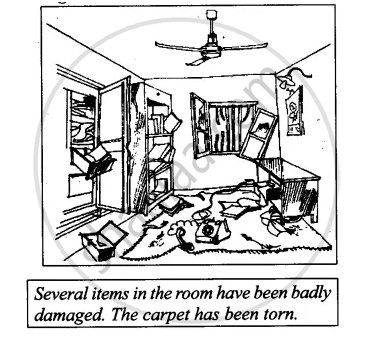
Inspector Narayan has been called to investigate a burglary. When he arrives, there is total chaos in the room. He makes notes about what has been damaged. You are Inspector Narayan. Look at the picture and complete the description, using the Present Perfect Passive.
Prevention is better than cure.
Swine flu has been declared (as) a pandemic.
In groups of four discuss the following.
(a) What has been done by the authorities to cope with the problem?
(b) What are the consequences of such a major world-wide infection?
Write out the answer to the questions as a flowchart using the passive form of the verb.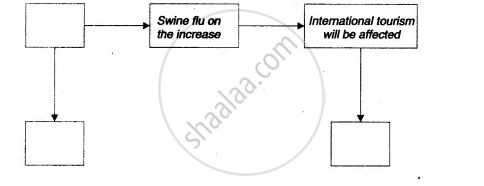
Divide yourselves into groups and collect information on the use of computers from three students, each from classes VI, IX and XI. Compile and summarise your answers to the questions above in the following table
| Class | Name Girl/Boy | Hours per week | If you reduce your computer time , how will you spend your leisure time ? | Why do you like to spend time at the computer ? | |||
| At the computer | Studying at home | Internet | Leisure | ||||
Read the following dialogue
Raghu : I think one of my snakes has escaped.
Sheela : Isn’t it dangerous? You really must stop collecting snakes, Raghu.
Raghu : But I like snakes – they are unusual pets.
Sheela : But I think it’s a dangerous thing to keep such pets.
Raghu : No, they’re not dangerous; they are really… .er… .quite friendly.
Sheela : Huh, snakes require a great deal of careful handling and are still a risk.
Raghu : i don’t mind. What matters is that I like them.
Sheela : Well, quite frankly, I hate them. They are awfully frightening to look at.
Raghu : Look, I am very careful and I handle them very gently. In fact, I don’t have many.
Sheela : Have you ever been bitten?
Raghu : Well, it’s true I’ve been bitten once or twice, but…
You are a friend who has overheard this conversation between Raghu and Sheela. Write to your sister reporting it. Give the conversation an interesting, unexpected or humorous ending. (The first part has been done for you.)
Janpath
5 January 2016
Dear Varsha
As you’re very interested in Raghu and his snakes, I thought I’d tell you about a conversation I heard between him and Sheela.
He told her he thought one of his snakes had escaped and, as usual, she told him to stop collecting them because they were dangerous. (Typical of Sheela, don’t you think?)
Pronouns
Direct speech indirect speech
| masculine | feminine | plural | |
| i | he | she | they |
| you | he | she | they |
| you | him | her | them |
| your | his | her | their |
| me | him | her | them |
| my | his | her | their |
| myself | himself | herself | themselves |
| we | they | ||
| use | them, their |
WORDS DENOTING TIME AND POSITION
When the reporting verb is in the past tense, certain words denoting nearness of
time and place are changed into words denoting distance.
It is treated necessary to change the words denoting nearness to words denoting
distance because, when we report the words of a person to somebody, the place
and time of the reporting is changed.
So the reported speech must be in line with the modified time and place.
| DIRECT SPEECH | INDIRECT SPEECH |
| this | that |
| these | those |
| now | then |
| ago | before |
| last night |
the previous night the night before |
| next day |
the following day the day after |
| today | the day |
| tonight | that night |
| yesterday |
the previous day the day before |
| tomorrow |
the next day the following day the day after |
| day before yesterday | the day before the previous day or two days before |
| day after tomorrow | the day after the next day ot in two days |
| week | the following week |
| now | then |
| here | there |
