Advertisements
Advertisements
Question
Write Kolbe’s reaction.
Advertisements
Solution
The treatment of sodium phenoxide with carbon dioxide at 398 K under the pressure of 6 atm followed by acid-hydrolysis, salicylic acid (o-hydroxybenzoic acid) is formed. This reaction is known as Kolbe’s reaction.

APPEARS IN
RELATED QUESTIONS
Answer in brief.
Give the reagents and conditions necessary to prepare phenol from Benzene sulfonic acid.
Answer in brief.
Give the equations of the reactions for the preparation of phenol from isopropyl benezene.
Answer in brief.
Give a simple chemical test to distinguish between ethanol and ethyl bromide.
An ether (A), C5H12O, when heated with excess of hot HI produce two alkyl halides which on hydrolysis form compound (B) and (C), oxidation of (B) gave and acid (D), whereas oxidation of (C) gave a ketone (E). Deduce the structural formula of (A), (B), (C), (D), and (E).
Write IUPAC name of crotonyl alcohol.
Write chemical equation of acetyl chloride with phenol
An unknown alcohol is treated with Lucas reagent. Explain how you will determine whether the alcohol is primary, secondary or tertiary. Indicate by chemical equation the reaction between isopropyl alcohol and Lucas reagent.
How will you bring about the following conversions?
isopropyl alcohol to acetone
Write the reactions for the preparation of carbolic acid from aniline.
What is the action of conc. H2SO4 on carbolic acid at 373 K.
Which alcohol is difficult to oxidise?
In the Lucas test for alcohols, the appearance of turbidity is due to the formation of ____________.
α-butylene when subjected to hydroboration oxidation reaction, yields ______.
The CORRECT decreasing order of boiling points for isomeric primary (1°), secondary (2°) and tertiary (3°) alcohols is ____________.
____________ will NOT undergo acetylation.
Phenoxide ion is more stable than phenol due to the ____________.
Identify the product B in following conversion.
\[\ce{Chlorobenzene + H2O ->[Cu, 673 K][Pressure] A ->[conc. H2SO4][373 K] B}\]
Which of the following conversion explains the acidic nature of alcohols?
Which isomer of C4H10O is optically active?
Identify the compound having highest boiling point from the following?
Identify the role of PDC from the following.
Name the catalyst used in commercial method of preparation of phenol.
What is the product obtained in Reimer - Tiemann reaction?
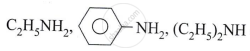
Arrange the following compounds in an increasing order of their solubility in water:
Explain the reaction of 1° and 2° alcohol with oxidising agent chromic anhydride (CrO3).
