Advertisements
Advertisements
Question
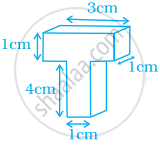
Work out the surface area of following shape (use π = 3.14).
Advertisements
Solution
Surface area of the figure
= 2[3 × 1 + 1 × 1 + 3 × 1] + 2[4 × 1 + 1 × 1 + 4 × 1] – [1 × 1 + 1 × 1]
= 2[3 + 1 + 3] + 2[4 + 1 + 4] – [1 + 1]
= 2[7] + 2[9] – [2]
= 14 + 18 – 2
= 32 – 2
= 30 cm2
APPEARS IN
RELATED QUESTIONS
A suitcase with measures 80 cm × 48 cm × 24 cm is to be covered with a tarpaulin cloth. How many metres of tarpaulin of width 96 cm is required to cover 100 such suitcases?
Identify the net which can be used to make cube (cut out copies of the net and try it):
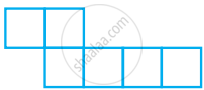
Identify the net which can be used to make cube (cut out copies of the net and try it):
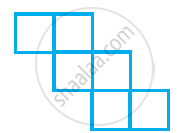
In a three-dimensional shape, diagonal is a line segment that joins two vertices that do not lie on the ______ face.
In the given figure, identify the different shapes involved.

What figure is formed if only the height of a cube is increased or decreased?
Find the area of the shaded portion in the following figure.

Find the area of the shaded portion in the following figure.

Find the volume of the given figure if volume = base area × height.

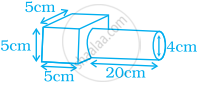
Work out the surface area of following shape (use π = 3.14).
Two dimensional figures are also called plane figures.
The circle, the square, the rectangle and the triangle are examples of plane figures.
The circle, the square, the rectangle and the triangle are examples of plane figures.
The circle, the square, the rectangle and the triangle are examples of plane figures.
The circle, the square, the rectangle and the triangle are examples of plane figures.
The circle, the square, the rectangle and the triangle are examples of plane figures.
The circle, the square, the rectangle and the triangle are examples of plane figures.
