Advertisements
Advertisements
Question
Find the area of the shaded portion in the following figure.

Advertisements
Solution
Area of shaded portion = Area of trapezium – Area of rectangle – Area of circle
Area of trapezium = `1/2` × [Sum of parallel sides] × Height
= `1/2 xx (120 + 160) xx 100`
= `1/2 xx 280 xx 100`
= `28000/2`
= 14000 cm2
Area of rectangle = Length × Breadth
= 40 × 20
= 800 cm2
Area of circle = πr2
= `22/7 xx 7 xx 7`
= 154 cm2
∴ Area of shaded portion = 14000 – 800 – 154 = 13046 cm2
APPEARS IN
RELATED QUESTIONS
Identify the net which can be used to make cube (cut out copies of the net and try it):
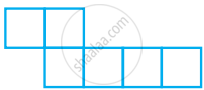
Identify the net which can be used to make cube (cut out copies of the net and try it):
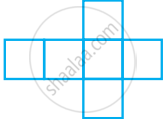
Identify the net which can be used to make cube (cut out copies of the net and try it):
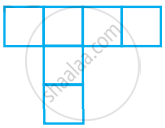
Make 8 triangles using 6 matchsticks. Try!
A pentagonal prism has ______ faces.
Use isometric dot paper to draw figure.
A rectangular prism with length 4 units, width 2 units and height 2 units.
Find the area of the shaded portion in the following figure.

Find the area of the shaded portion in the following figure.

Work out the surface area of following shape (use π = 3.14).
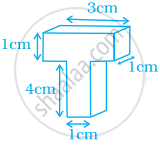
Work out the surface area of following shape (use π = 3.14).
A solid with no vertex is ______.
Two dimensional figures are also called plane figures.
The circle, the square, the rectangle and the triangle are examples of plane figures.
The circle, the square, the rectangle and the triangle are examples of plane figures.
The circle, the square, the rectangle and the triangle are examples of plane figures.
The circle, the square, the rectangle and the triangle are examples of plane figures.
The circle, the square, the rectangle and the triangle are examples of plane figures.
The circle, the square, the rectangle and the triangle are examples of plane figures.
