Advertisements
Advertisements
Question
Why does current in a steady state not flow in a capacitor connected across a battery? However momentary current does flow during charging or discharging of the capacitor. Explain.
Advertisements
Solution
In steady state condition, voltage across the capacitor nearly equals to the voltage of the charging source. Hence net voltage acting in the circuit is zero. Due to this there is no flow of charge (current) through the circuit and hence the capacitor.
Now we know for an uncharged capacitor the potential difference across the capacitor is zero. So when it is connected to a battery, the battery begins to charge it by withdrawing the free electrons from one plate connected with the positive terminal of the battery of the capacitance and deposit on the other plate of the capacitor. So, due to this flow of charge, there exist a momentary current while charging of the capacitor. Now when the capacitor is fully charged i.e. voltage across the capacitor nearly equals to the voltage of the charging source, the current in the circuit vanishes.
Now in case of discharging of a charged capacitor, the battery gets replaced by a wire of say resistance R. Hence the capacitor itself acts as a battery now and flow of charge exists in the circuit from negative plate to the positive plate of the battery. This leads to momentary current in the circuit. As soon as the all the positive charges on one plate gets neutralised by the negative charges on the other plate, the flow of charge stops and hence the current.
APPEARS IN
RELATED QUESTIONS
In a series LCR circuit, obtain the condition under which watt-less current flows in the circuit ?
Derive an expression for the average power consumed in a series LCR circuit connected to a.c. source in which the phase difference between the voltage and the current in the circuit is Φ.
A coil of resistance 40 Ω is connected across a 4.0 V battery. 0.10 s after the battery is connected, the current in the coil is 63 mA. Find the inductance of the coil.
The potential difference across the resistor is 160V and that across the inductor is 120V. Find the effective value of the applied voltage. If the effective current in the circuit be 1.0 A, calculate the total impedance of the circuit.
In a series LCR circuit the voltage across an inductor, capacitor and resistor are 20 V, 20 V and 40 V respectively. The phase difference between the applied voltage and the current in the circuit is ______.
Consider the LCR circuit shown in figure. Find the net current i and the phase of i. Show that i = v/Z`. Find the impedance Z for this circuit.

Three students, X, Y and Z performed an experiment for studying the variation of ac with frequency in a series LCR circuit and obtained the graphs as shown below. They all used
- an AC source of the same emf and
- inductance of the same value.

- Who used minimum resistance?
- In which case will the quality Q factor be maximum?
- What did the students conclude about the nature of impedance at resonant frequency (f0)?
- An ideal capacitor is connected across 220 V, 50 Hz, and 220 V, 100 Hz supplies. Find the ratio of current flowing through it in the two cases.
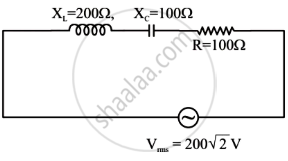
In the given circuit, rms value of current (Irms) through the resistor R is:
When a capacitor is connected in series LR circuit, the alternating current flowing in the circuit ______
