English

Unpolarised light is passed through a polaroid P1. When this polarised beam passes through another polaroid P2 and if the pass axis of P2 makes angle θ with the pass axis of P1 - Physics

Advertisements
Advertisements

Question

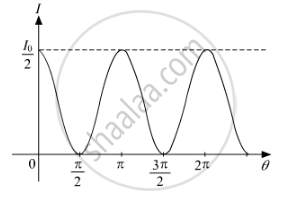
Unpolarised light is passed through a polaroid P1. When this polarised beam passes through another polaroid P2 and if the pass axis of P2 makes angle θ with the pass axis of P1, then write the expression for the polarised beam passing through P2. Draw a plot showing the variation of intensity when θ varies from 0 to 2π.

Advertisements

Solution

When unpolarised light passes through the polariser P1 the intensity drops to half that is `I_o/2` and when this polarised light passes through the polariser P2 the instensity of the emitted light is

`I=I_0/2cos^2 theta`

(θ is the angle between polariser P1 and P2)

The instensity distrubution is as shown below:
shaalaa.com
  Is there an error in this question or solution?
2016-2017 (March) All India Set 1

RELATED QUESTIONS

What is a Polaroid?


Draw a neat labelled diagram showing the plane of vibration and plane of polarisation for polarised light.


For a glass plate as a polariser with refractive index 1.633, calculate the angle of incidence at which light is polarised.


Three identical polaroid sheets P1, P2 and P3 are oriented so that the pass axis of P2 and P3 are inclined at angles of 60° and 90° respectively with the pass axis of P1. A monochromatic source S of unpolarised light of intensity I0 is kept in front of the polaroid sheet P1 as shown in the figure. Determine the intensities of light as observed by the observer at O, when polaroid P3 is rotated with respect to P2 at angles θ = 30° and 60°.


Show, using a simple polaroid, that light waves are transverse in nature. Intensity of light coming out of a polaroid does not change irrespective of the orientation of the pass axis of the polaroid. Explain why.


Find an expression for intensity of transmitted light when a polaroid sheet is rotated between two crossed polaroids. In which position of the polaroid sheet will the transmitted intensity be maximum?


How does one demonstrate, using a suitable diagram, that unpolarised light when passed through a Polaroid gets polarised?


Using the phenomenon of polarisation, show how the transverse nature of light can be demonstrated.


A ray of light passes from a vacuum to a medium of refractive index (μ). The angle of
incidence is found to be twice the angle of refraction. The angle of incidence is _______.

A) `cos^(-1)(mu/2)`

B) cos−1(μ)

C)  `2 cos^(-1) (mu/2)`

D) `2 sin^(-1) (mu/2)`


The reflected light is found to be plane polarised when an unpolarized light falls on a denser medium at 60° with the normal. Find the angle of refraction and critical angle of incidence for total internal reflection in the denser to rarer medium reflection.


Share
Notifications

Englishहिंदीमराठी


      Forgot password?
Use app×