Advertisements
Advertisements
प्रश्न
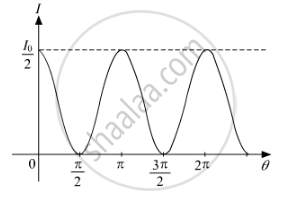
Unpolarised light is passed through a polaroid P1. When this polarised beam passes through another polaroid P2 and if the pass axis of P2 makes angle θ with the pass axis of P1, then write the expression for the polarised beam passing through P2. Draw a plot showing the variation of intensity when θ varies from 0 to 2π.
Advertisements
उत्तर
When unpolarised light passes through the polariser P1 the intensity drops to half that is `I_o/2` and when this polarised light passes through the polariser P2 the instensity of the emitted light is
`I=I_0/2cos^2 theta`
(θ is the angle between polariser P1 and P2)
The instensity distrubution is as shown below:
संबंधित प्रश्न
With the help of neat diagram, explain how non-polar dielectric material is polarised in external electric field of increasing intensity. Define polarisation in dielectrics.
The refractive indices of water for red and violet colours are 1.325 and 1.334 respectively.
Find the difference between the velocities of rays for these two colours in water. (c = 3 × 10⁸ m/s)
Which of the following properties shows that light is a transverse wave?
What is polarisation?
What is a analyser?
State and obtain Malus’ law.
Discuss about pile of plates.
Consider a light beam incident from air to a glass slab at Brewster’s angle as shown in figure. A polaroid is placed in the path of the emergent ray at point P and rotated about an axis passing through the centre and perpendicular to the plane of the polaroid.

Can reflection result in plane polarised light if the light is incident on the interface from the side with higher refractive index?
An unpolarized light beam is incident on the polarizer of a polarization experiment and the intensity of light beam emerging from the analyzer is measured as 100 Lumens. Now, if the analyzer is rotated around the horizontal axis (direction of light) by 30° in clockwise direction, the intensity of emerging light will be ______ Lumens.
