Advertisements
Advertisements
प्रश्न
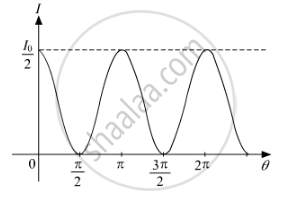
Unpolarised light is passed through a polaroid P1. When this polarised beam passes through another polaroid P2 and if the pass axis of P2 makes angle θ with the pass axis of P1, then write the expression for the polarised beam passing through P2. Draw a plot showing the variation of intensity when θ varies from 0 to 2π.
Advertisements
उत्तर
When unpolarised light passes through the polariser P1 the intensity drops to half that is `I_o/2` and when this polarised light passes through the polariser P2 the instensity of the emitted light is
`I=I_0/2cos^2 theta`
(θ is the angle between polariser P1 and P2)
The instensity distrubution is as shown below:
संबंधित प्रश्न
Three identical polaroid sheets P1, P2 and P3 are oriented so that the pass axis of P2 and P3 are inclined at angles of 60° and 90° respectively with the pass axis of P1. A monochromatic source S of unpolarised light of intensity I0 is kept in front of the polaroid sheet P1 as shown in the figure. Determine the intensities of light as observed by the observer at O, when polaroid P3 is rotated with respect to P2 at angles θ = 30° and 60°.

Why does an unpolarised light incident on a polaroid get linearly polarised ?
When a low flying aircraft passes overhead, we sometimes notice a slight shaking of the picture on our TV screen. Suggest a possible explanation.
Light transmitted by Nicol prism is ______.
Discuss polarisation by selective absorption.
State and obtain Malus’ law.
List the uses of polaroids.
What is normal focusing?
Can reflection result in plane polarised light if the light is incident on the interface from the side with higher refractive index?
An unpolarized light beam is incident on the polarizer of a polarization experiment and the intensity of light beam emerging from the analyzer is measured as 100 Lumens. Now, if the analyzer is rotated around the horizontal axis (direction of light) by 30° in clockwise direction, the intensity of emerging light will be ______ Lumens.
