Advertisements
Advertisements
Question
Why does acetylation of –NH2 group of aniline reduce its activating effect?
Advertisements
Solution
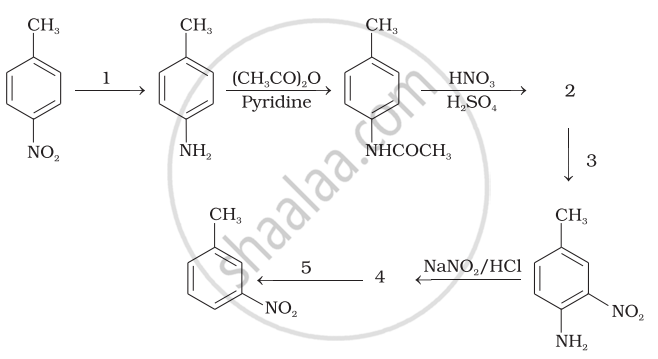
Direct nitration of aniline is not possible on account of oxidation of –NH2 group. However, nitration can be carried after protecting the –NH2 group by acetylation to give acetanilide which is then nitrated and finally hydrolysed to give o- and p-nitroanilines.
The acetyl group being electron-withdrawing attracts the lone pair of electrons of the N-atom towards carbonyl group.

As a result, the activating effect –NH2 group is reduced i.e., the lone pair of electrons on nitrogen is less available for donation to benzene ring by resonance. Therefore, activating effect of –NHCOCH3 group is less than that of –NH2 group.
APPEARS IN
RELATED QUESTIONS
Illustrate the following reaction giving suitable example in each case: Diazotisation
Write equations of the following reactions:
Acetylation of aniline
Arenium ion involved in the bromination of aniline is:
(i)

(ii)

(iii)

(iv)

Predict the product of reaction of aniline with bromine in non-polar solvent such as \[\ce{CS2}\].
Why is aniline soluble in aqueous HCl?
How will you carry out the following conversions?
toluene `->` p-toluidine
How will you carry out the following conversions?
p-toluidine diazonium chloride `→` p-toluic acid
Predict the reagent or the product in the following reaction sequence.
Which of the following statement about primary amines is false?
Which of the following is true characteristic feature of aniline?
Which of the following is the most stable diazonium salt?
Benzene diazonium chloride is a ______.
Consider the following compounds:
(i) p-methyl aniline
(ii) N, N-dimethylaniline
(iii) N-ethyl aniline
(iv) N-ethyl-N-methyl aniline
The compounds which do not form diazonium salt with ice-colds NaNO2 and HCl are:
Identify A and B for the following reaction:

What are polymers?
How will the following be converted? (Give chemical equation)
Aniline to benzene diazonium chloride.
Given below are two statements:
Statement I: Benzenediazonium salt is prepared by the reaction of aniline with nitrous acid at 273-278 K. It decomposes easily in the dry state.
Statement II: Insertion of iodine into the benzene ring is difficult and hence, iodobenzene is prepared through the reaction of benzenediazonium salt with KI.
In the light of the above statements, choose the most appropriate answer from the options given below:
