Advertisements
Advertisements
Question
While packing the hamper, George and Harris do a number of foolish and funny thing. Tick the statements that are true.
(i) They started with breaking a cup.
(ii) They also broke a plate.
(iii) They squashed a tomato.
(iv) They trod on the butter.
(v) They stepped on a banana.
(vi) They put things behind them, and couldn’t find them.
(vii) They stepped on things.
(viii) They packed the pictures at the bottom and put heavy things on top.
(ix) They upset almost everything.
(x) They were very good at packing.
Advertisements
Solution
Statements (i), (iii), (iv), (vi) and (vii) are true.
RELATED QUESTIONS
Thinking about the Text
Here are some headings for paragraphs in the text. Write the number(s) of the
paragraph(s) for each title against the heading. The first one is done for you.
| (i) | Einstein’s equation 9 |
| (ii) | Einstein meets his future wife |
| (iii) | The making of a violinist |
| (iv) | Mileva and Einstein’s mother |
| (v) | A letter that launched the arms race |
| (vi) | A desk drawer full of ideas |
| (vii) | Marriage and divorce |
Thinking about the Text
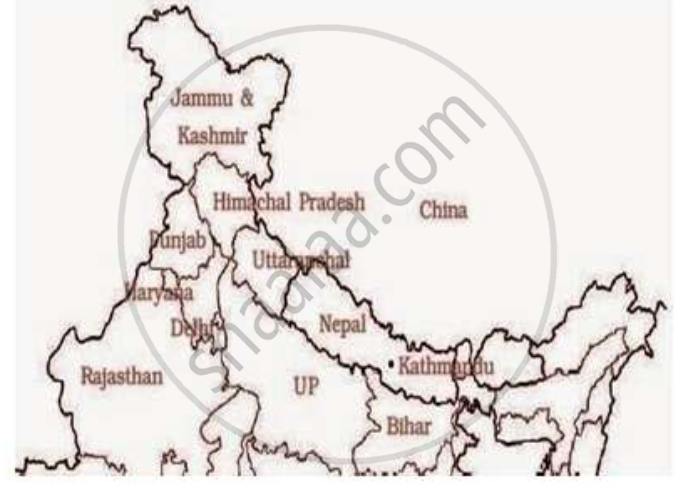
On the following map mark out the route, which the author thought of but did not take, to Delhi.
Subject Verb Agreement.
A verb must be in the same number and person as its subject e.g.
(a) A man and his wife have lived here since January 2009.
(b) Arun, a great scholar, is dead.
(c) Either James or Peter is to be promoted.
( d) The horse as well as its rider was hurt by the fall.
(e) Not only India, but also the whole world recognises Gandhiji's
achievements
(f) Eachman was rewarded.
(g) Every tree has been saved.
(h) The Adventures of Tom Jones is a great novel.
India's Major concerns
Read the following paragraph. Then work in pairs and list the different ways in which you can contribute to save Mother Earth. As an individual you can make a major contribution towards reducing India's over all emission level.

How to save the Environment at Home
There are plenty of small steps that people can take at home to help save the environment. While the eco-footprint of each step is small, thousands of people doing the same thing can make a difference. In making some small changes to the way that you do things at home, you are gradually making a difference, even as an individual. You will kill costs and improve your health at the same time, so helping to save the environment isn't an entirely altruistic exercise after all!
|
SAVE MOTHER EARTH CAMPAIGN |
The black man's face bespoke revenge
As the fire passed from his sight.
For all he saw in his stick of wood
Was a chance to spite the white.
The last man of this forlorn group
Did nought except for gain.
Giving only to those who gave
Was how he played the game.
Their logs held tight in death's still hands
Was proof of human sin.
They didn't die from the cold without
They died from the cold within.
Read the lines given above and answer the question that follow.
Discuss personification as used by the poet.
Some are Purple and gold flecked grey
For she who has journeyed through life midway,
Whose hands have cherished , whose love has blest,
And cradled fair sons on her faithful breast,
And serves her household in fruitful pride,
And worship the gods at her husband's side.
Read the lines given above and answer the question that follow:
What in the passage will repel a modern woman?
The waves beside them danced, but they
Out-did the sparkling leaves in glee;
A poet could not be but gay,
In such a jocund company!
I gazed-and gazed-but little thought
What wealth the show to me had brought:
Read the lines given above and answer the question that follow.
Which wealth is referred to by the poet?
Most terribly cold it was; it snowed, and was nearly quite dark, and evening— the last evening of the year. In this cold and darkness there went along the street a poor little girl, bareheaded, and with naked feet. When she left home she had slippers on, it is true; but what was the good of that? They were very large slippers, which her mother had hitherto worn; so large were they; and the poor little thing lost them as she scuffled away across the street, because of two carriages that rolled by dreadfully fast.
One slipper was nowhere to be found; the other had been laid hold of by an urchin, and off he ran with it; he thought it would do capitally for a cradle when he some day or other should have children himself. So the little maiden walked on with her tiny naked feet, that were quite red and blue from cold. She carried a quantity of matches in an old apron, and she held a bundle of them in her hand. Nobody had bought anything of her the whole livelong day; no one had given her a single farthing. She crept along trembling with cold and hunger—a very picture of sorrow, the poor little thing!
Read the extract given below and answer the question that follow.
Does the author give us a glimpse into the Victorian society?
What does ti» poet wish for al the end ~f the poem? What does tl1e poem tell the readers about the poet? Give a reason to justify yow· answer.
Read the extract given below and answer the questions that follow:
"Now tell us what it was all about"
Young Peterkin, he cries.
And little Willhelmines looks up
With wonder - waiting eyes,
"Now tell us all about the war,
And what they fought each other for".
- After Blenheim, Robert Southey
(i) Who are Peterkin and Wilhelmine? How does the poet describe the scene at the beginning of the poem?
(ii) What did Young Peterkin find and where? Describe it?
(iii) Who is referred to as "each other"? What did they fight for?
(iv) To whom are the words in the extract addressed? How was this person's family affected by the war?
(v) What, according to the poet, are the consequences that are often associated with great and famous victories? What message does the poet want to convey to the readers?
What did Number One and Number Two suggest should be done about the alien spacecraft?
Find in the poem lines that match the following. Read both one after the other.
He says cats are better.
Why gaps are left between buildings during construction?
Mention the year when the cricket rules were written for the first time
Describe Golu’s meeting with the crocodile.
What does the poet refer to as ‘they’ in the following stanza?
"I saw a snake and ran away Some snakes are
dangerous, they say"
With your partner try to guess the meaning of the underlined phrase.
And somehow we fell out.
What else do you think Nishad and Maya will find out about him? How? Will they ever be friends? Think about these questions and write a paragraph or two to continue the story.
The short story 'The Little Match Girl' can be called a fairy tale because ______.
Which natural element plays a crucial role in the end of the story There Will Come Soft Rains?
