Advertisements
Advertisements
Question
Discuss in pair and answer question below in a short paragraph (30 − 40 words.
What did George and Harris offer to pack and why?
Advertisements
Solution
George and Harris offered to pack the hampers because It was getting late and they thought that Jerome had taken too much of time. They also wanted to show their skill to Jerome.
RELATED QUESTIONS
Answer of these question in a short paragraph (30–40 words).
Who helped her to continue with music? What did he do and say?
The Narrative Present
Notice the incomplete sentences in the following paragraphs. Here the writer is using incomplete sentences in the narration to make the incident more dramatic or immediate. Can you rewrite the paragraph in complete sentences?
(You can begin: The vet and I made a dash back to the car. Bruno was still floundering…)
(i) A dash back to car. Bruno still floundering about on his stumps, but clearly weakening rapidly; some vomiting, heavy breathing, with heaving flanks and gaping mouth. Hold him everybody! In goes the hypodermic – Bruno squeals – 10 c.c. of the antidote enters his system without a drop being wasted. Then minutes later: condition unchanged! Another 10 c.c. injected! Ten minutes later: breathing less stertorous – Bruno can move his arms and legs a little although he cannot stand yet. Thirty minutes later: Bruno gets up and has a great feed! He looks at us disdainfully, as much as to say, ‘What’s barium carbonate to a big black bear like me?’ Bruno is still eating.
(ii) In the paragraphs above from the story the verbs are in the present tense (eg. hold, goes, etc.). This gives the reader an impression of immediacy. The present tense is often used when we give a commentary on a game (cricket, football, etc.), or tell a story as if it is happening now. It is, therefore, called the narrative present. You will read more about the present tense in Unit 10
Look at the words the poet uses to describe what he sees and hears at Innisfree
- Bee-loud glade
- Evenings full of the linnet’s wings
- Lake water lapping with low sounds
What pictures do these words create in your mind?
Why does the author say, “Toto was not the sort of pet we could keep for long”?
The poem is about a brook. A dictionary would define a brook, as a stream or a
small river. Read the poem silently first. After the first reading, the teacher will
make you listen to a recording of the poem. What do you think the poem is all
about?
I come from haunts of coot and hern;
I make a sudden sally
And sparkle out among the fern,
To bicker down a valley.
By thirty hills I hurry down,
Or slip between the ridges,
By twenty thorpes, a little town,
And half a hundred bridges.
Till last by Philip's farm I flow
10 To join the brimming river,
For men may come and men may go,
But I go on for ever.
I chatter over stony ways,
In little sharps and trebles,
15 I bubble into eddying bays,
I babble on the pebbles.
With many a curve my banks I fret
By many a field and fallow,
And many a fairy foreland set
20 With willow-weed and mallow.
I chatter, chatter, as I flow
To join the brimming river,
For men may come and men may go,
But I go on for ever.
25 I wind about, and in and out,
With here a blossom sailing,
And here and there a lusty trout,
And here and there a grayling,
And here and there a foamy flake
30 Upon me, as I travel
With many a silvery waterbreak
Above the golden gravel,
And draw them all along, and flow
To join the brimming river
35 For men may come and men may go,
But I go on for ever.
I steal by lawns and grassy plots,
I slide by hazel covers
I move the sweet forget-me-nots
40 That grow for happy lovers.
I slip, I slide, I gloom, I glance,
Among my skimming swallows;
I make the netted sunbeam dance
Against my sandy shallows.
45 I murmur under moon and stars
In brambly wildernesses;
I linger by my shingly bars;
I loiter round my cresses;
And out again I curve and flow
50 To join the brimming river,
For men may come and men may go,
But I go on for ever.
About the Poet
Lord Tennyson (1809-92) was born in Lincolnshire. Poet Laureate for over 40 years, Tennyson is representative of the Victorian age. His skilled craftsmanship and noble ideals retained a large audience for poetry in an age when the novel was engrossing more and more readers. Tennyson's real contribution lies in his shorter poems like The Lady of Shallot, The Princess, Ulysses, The Palace of Art etc. His fame rests on his perfect control of sound, the synthesis of sound and meaning, and the union of visual and musical.
Listen to one of William Wordsworth's poems, that describes a memorable
experience he had, while out on a walk. (Your teacher will play a recording.)
Listen to the poem at least twice.
a) Read the second stanza again, in which Wordsworth compares the solitary
reaper's song with the song of the nightingale and the cuckoo. On the basis of
your reading (and your imagination), copy and complete the table below. (Work
in groups of four, then have a brief class discussion.
| Place | Heard by | Impact on listener | |
| Solitary Reaper | Scottish Highlands | the poet | holds him spellbound |
| Nightingale | |||
| Cuckoo |
b) Why do you think Wordsworth has chosen the song of the nightingale and the
cuckoo, for comparison with the solitary reaper's song?
c) As you read the second stanza, what images come to your mind? Be ready to
describe them in your own words, to the rest of the class. (Be imaginative
enough and go beyond what the poet has written.)
Read the song once again.
I am dotted silver threads dropped from heaven
By the gods. Nature then takes me, to adorn
Her fields and valleys.
I am beautiful pearls, plucked from the
Crown of Ishtar by the daughter of Dawn
To embellish the gardens.
When I cry the hills laugh;
When I humble myself the flowers rejoice;
When I bow, all things are elated.
The field and the cloud are lovers
And between them I am a messenger of mercy.
I quench the thirst of the one;
I cure the ailment of the other.
The voice of thunder declares my arrival;
The rainbow announces my departure.
I am like earthly life which begins at
The feet of the mad elements and ends
Under the upraised wings of death.
I emerge from the heart of the sea and
Soar with the breeze. When I see a field in
Need, I descend and embrace the flowers and
The trees in a million little ways.
I touch gently at the windows with my
Soft fingers, and my announcement is a
Welcome song. All can hear, but only
The sensitive can understand.
I am the sigh of the sea;
The laughter of the field;
The tears of heaven.
So with love -
Sighs from the deep sea of affection; Laughter from the colourful
field of the spirit; Tears from the endless heaven of memories.
About the Poet
Kahlil Gibran (1883-1931) was a Lebanese-American artist, poet and writer. His
poetry is notable for its use of formal language as well as insights on topics of life using
spiritual terms. One of his most notable lines of poetry in the English-speaking world is
from Sand and Foam (1926) which reads 'Half of what I say is meaningless, but I say
it so that the other half may reach you.'
Now, it is your turn. Write and produce your own radio programme. You will need to select your own content. The following are some ideas. You are free, of course, to add your own ideas. Remember, the programme must be in English.
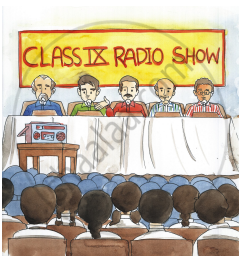
- News stories: about people in your class, about school, about sports (school and local), about the local community
- Comedy: jokes, short plays
- Interviews: with teachers, with exstudents of your school, with a Class IX student who has recently done something very interesting
- Games: general knowledge quiz, panel game, word game
- Advertisements: for shops/industries in the local community, things ‘for sale’ and ‘wanted’ by students
- Local sites: monuments/sites of historical importance and of tourist interest
- Special reports: e.g. safety at school, examination results, school uniform, school assemblies
- Interesting people: role-play interviews with film stars, sports personalities, TV personalities, etc.
- Entertainment reviews: music, films, videos, books, etc.
- Plays
- Songs with lyrics
- Speeches on important personalities
- Tele conference video conference with students, teachers, experts
He flungs himself down in a corner to recoup from the fatigue of his visit to the shop. His wife said, “You are getting no sauce today, nor anything else. I can’t find anything to give you to eat. Fast till the evening, it’ll do you good. Take the goats and be gone now,” she cried and added, “Don’t come back before the sun is down.”
Read the extract given below and answer the question that follow.
What lie did Muni tell the shopkeeper?
Answer the following question.
The bear grew up but “he was a most amiable bear”. Give three examples to prove this
How was Mahmoud, the cook, attached to the tiger cub?
Give a character sketch of the shepherd. What qualities pleased the king?
Vijay Singh complained of insects in the cave. What was he referring to, and why?
Who was Vijay Singh? What did he look like?
Complete the following sentence
The chatter is electrical because ______
Talk to your partner and say whether the following statement is true or false.
No animal can survive without water.
What does the rebel do?
Study the following phrases and their meanings. Use them appropriately to complete the sentences that follow.
I promise to ………….. on your brother when I visit Lucknow next.
Read the extract given below and answer the questions that follow:
|
Bassanio: Portia: |
- Who is on trial?
Why is this person on trial? [3] - Explain in your own words Bassanio’s request to portia in the given extract.
What reason does he give for his request? [3] - How does Portia respond to Bassanio's request? What TWO reasons does she give for her response? [3]
- Who does Bassanio refer to as ‘this cruel devil’? What is this person's response to Portia’s words in the given extract? [3]
- How is the ‘cruel devil’ punished at the end of the trial?
How fair, in your opinion, is this punishment? Justify your response. [4]
