Advertisements
Advertisements
Question
Which of the following ‘suffixes’ used for units of classification in plants indicates a taxonomic category of ‘family’?
Options
– Ales
– Onae
– Aceae
– Ae
Advertisements
Solution
– Aceae
Explanation:
You can use family names such as Solanaceae, Fabaceae, and so on
APPEARS IN
RELATED QUESTIONS
Can you identify the correct sequence of taxonomical categories?
Define and understand the following term:
Phylum
Define and understand the following term:
Class
Define and understand the following term:
Genus
Illustrate the taxonomical hierarchy with suitable examples of a plant and an animal.
Name one example of the animal which shows the following characteristics:
Fixed animals with a pore-bearing body:
Find the odd one out. Give reason.
sea urchin, starfish, brittle star, jellyfish
Observe the figure and answer the questions given below.
a) To which phylum these organisms belong?
b) Name the substance with which their body is covered.
c) Name their organs of locomotion.

Corals are
Write true (T) or false (F)
Starting from Class, Species comes before the Genus.
Label a,b,c and d. given in Fig. 7.1 Give the function of (b)
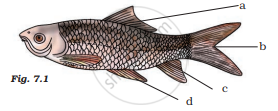
Write names of few thallophytes. Draw a labelled diagram of Spirogyra.
Identity the incorrect statement:
In the taxonomical hierarchy, the category below the level of order is ______.
As we go from species to kingdom in a taxonomic hierarchy, the number of common characteristics ______.
Match the following and choose the correct option:
| Column I | Column II |
| A. Family | i. Tuberosum |
| B. Kingdom | ii. Polymoniales |
| C. Order | iii. Solanum |
| D. Species | iv. Plantae |
| E. Genus | v. Solanacea |
What is the difference between flora, fauna and vegetation? Eichhornia crassipes is called as an exotic species while Rauwolfia serpentina is an endemic species in India. What do these terms exotic and endemic refer to?
Define a taxon. What is meant by taxonomic hierarchy. Give a flow diagram from the lowest to highest category for a plant and an animal. What happens to the number of individuals and number of shared characters as we go up the taxonomical hierarchy?
