Advertisements
Advertisements
Question
Try to collect all the currently accepted meanings for the word ‘species’. Discuss with your teacher the meaning of species in the case of higher plants and animals on one hand and bacteria on the other:
Advertisements
Solution
- Species hold a significant position in classification. In terms of taxonomy, it is the lowest. In order for them to be able to freely interbreed and generate fruitful children, it is a natural population of individuals or groups of populations that resemble one another in all important morphological and reproductive traits.
- A genetically unique and reproductively separated natural population is another term for each species. "A group of actually or potentially interbreeding populations that are reproductively isolated from other such groups" is the definition of a species, according to Mayr (1964).
- The word "species" in higher plants and animals designates a collection of individuals with the capacity to freely interbreed and generate progeny.
- Interbreeding, however, is not the ideal criterion for dividing species when it comes to bacteria, as they often reproduce asexually. The processes that bacteria refer to as sexual reproduction conjugation, transformation, and transduction also do not match up with actual interbreeding.
- Therefore, a wide range of other traits are taken into account when classifying bacteria, including molecular homology and biochemical, physiological, ecological, and morphological traits.
APPEARS IN
RELATED QUESTIONS
Define and understand the following term:
Phylum
Define and understand the following term:
Order
Define and understand the following term:
Genus
Name one example of the animal which shows the following characteristics:
Fixed animals with a pore-bearing body:
Find the odd one out. Give reason.
sea urchin, starfish, brittle star, jellyfish
Find the odd one out. Give reason.
jellyfish, hydra, sea anemone, butterfly
Amphibians do not have the following
Corals are
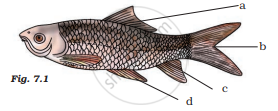
Label a,b,c and d. given in Fig. 7.1 Give the function of (b)
Fill in the boxes given in Fig. 7.2 with appropriate characteristics/plant group (s)

Which is not an insect?
Order is a number of related families having common characters placed in an order.
Name the three germ layers.
Identity the incorrect statement:
Which one of the following belongs to the family Muscidae?
Genus represents ______.
Linnaeus is considered as Father of Taxonomy. Name two other botanists known for their contribution to the field of plant taxonomy?
International Code of Botanical Nomenclature (ICBN) has provided a code for classification of plants. Give hierarchy of units of classification botanists follow while classifying plants and mention different ‘Suffixes’ used for the units.
Define a taxon. What is meant by taxonomic hierarchy. Give a flow diagram from the lowest to highest category for a plant and an animal. What happens to the number of individuals and number of shared characters as we go up the taxonomical hierarchy?
