Advertisements
Advertisements
Question
How are organisms classified?
Advertisements
Solution
The classification of living organisms is based on their similar characteristics, body structure, and biological features.
- All organisms are first classified into living and non-living categories.
- Then, living organisms are further divided into two main groups: Plants and Animals.
- Animals are classified into different groups based on their body structure, such as:
- Vertebrates (Ksheryuki) and Invertebrates (Aksheruki)
- Mammals, Birds, Reptiles, Amphibians, and Fishes
The scientist Carl Linnaeus developed the Binomial Nomenclature system, which is used for the classification of living organisms.
RELATED QUESTIONS
Can you identify the correct sequence of taxonomical categories?
Try to collect all the currently accepted meanings for the word ‘species’. Discuss with your teacher the meaning of species in the case of higher plants and animals on one hand and bacteria on the other:
Find the odd one out. Give reason.
sea urchin, starfish, brittle star, jellyfish
Corals are
______ has smallest number of organisms with maximum number of similar characters
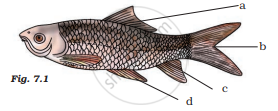
Label a,b,c and d. given in Fig. 7.1 Give the function of (b)
Which is not an insect?
Identity the incorrect statement:
Which one of the following belongs to the family Muscidae?
Match the following and choose the correct option:
| Column I | Column II |
| A. Family | i. Tuberosum |
| B. Kingdom | ii. Polymoniales |
| C. Order | iii. Solanum |
| D. Species | iv. Plantae |
| E. Genus | v. Solanacea |
