Advertisements
Advertisements
Question
Corals are
Options
Poriferans attached to some solid support
Cnidarians, that are solitary living
Poriferans present at the sea bed
Cnidarians that live in colonies
Advertisements
Solution
Cnidarians that live in colonies
Explanation -
Corals are cnidarians (coelenterates) that live in colonies. Examples of some corals are Corallium (red coral), Meandrina (brain coral), Astraea (star coral), etc.
APPEARS IN
RELATED QUESTIONS
Try to collect all the currently accepted meanings for the word ‘species’. Discuss with your teacher the meaning of species in the case of higher plants and animals on one hand and bacteria on the other:
Observe the figure and answer the questions given below.
a) To which phylum these organisms belong?
b) Name the substance with which their body is covered.
c) Name their organs of locomotion.

Identify my class/phylum and give one example of it:
I have mammary glands and exoskeletons in the form of hair.
How are organisms classified?
Amphibians do not have the following
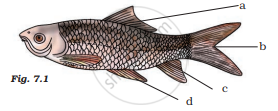
Label a,b,c and d. given in Fig. 7.1 Give the function of (b)
Write names of few thallophytes. Draw a labelled diagram of Spirogyra.
Linnaeus is considered as Father of Taxonomy. Name two other botanists known for their contribution to the field of plant taxonomy?
What is the difference between flora, fauna and vegetation? Eichhornia crassipes is called as an exotic species while Rauwolfia serpentina is an endemic species in India. What do these terms exotic and endemic refer to?
Define a taxon. What is meant by taxonomic hierarchy. Give a flow diagram from the lowest to highest category for a plant and an animal. What happens to the number of individuals and number of shared characters as we go up the taxonomical hierarchy?
