Advertisements
Advertisements
Question
International Code of Botanical Nomenclature (ICBN) has provided a code for classification of plants. Give hierarchy of units of classification botanists follow while classifying plants and mention different ‘Suffixes’ used for the units.
Advertisements
Solution
As per the ICBN, various hierarchies of units for classifying plants and suffixes used for such hierarchies are as follows:
| Hierarchy | Suffix |
| Kingdom | Plantae |
| Division | Photo |
| Class | Ae |
| Order | Ales |
| Family | Ease or - Cease |
| Genus | It is the first term of an organism's scientific name, which usually has a Latin origin and is written in italics. |
| Species | It is the second term of the scientific name, usually of Latin origin and written in italics. |
APPEARS IN
RELATED QUESTIONS
Give some examples of taxa at different hierarchical levels.
Define and understand the following term:
Class
Illustrate the taxonomical hierarchy with suitable examples of a plant and an animal.
Name one example of the animal which shows the following characteristics:
Fixed animals with a pore-bearing body:
Find the odd one out. Give reason.
sea urchin, starfish, brittle star, jellyfish
______ is a cold blooded animal.
Amphibians do not have the following
Write true (T) or false (F)
Starting from Class, Species comes before the Genus.
Label a,b,c and d. given in Fig. 7.1 Give the function of (b)
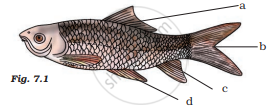
You are given leech, Nereis, Scolopendra, prawn and scorpion; and all have segmented body organisation. Will you classify them in one group? If no, give the important characters based on which you will separate these organisms into different groups.
In the system of classification, which one of the following is NOT a category?
Which one of the following belongs to the family Muscidae?
Which of the following ‘suffixes’ used for units of classification in plants indicates a taxonomic category of ‘family’?
Match the following and choose the correct option:
| Column I | Column II |
| A. Family | i. Tuberosum |
| B. Kingdom | ii. Polymoniales |
| C. Order | iii. Solanum |
| D. Species | iv. Plantae |
| E. Genus | v. Solanacea |
What is the difference between flora, fauna and vegetation? Eichhornia crassipes is called as an exotic species while Rauwolfia serpentina is an endemic species in India. What do these terms exotic and endemic refer to?
