Advertisements
Advertisements
Question
When a screw gauge with a least count of 0.01 mm is used to measure the diameter of a wire, the reading on the sleeve is found to be 1 mm and the reading on the thimble is found to be 27 divisions.
(i) What is the diameter of the wire in cm?
(ii) If the zero error is +0.005 cm, what is the correct diameter?
Advertisements
Solution
(i) L.C. of screw gauge = 0.01 mm or 0.001 cm
Main scale reading = 1 mm or 0.1 cm
No. of division of circular head in line with the base line (p) = 27
Circular scale reading = (p) × L.C.
= 27 × 0.001 cm
= 0.027 cm
Diameter (Total reading) = M.s.r. + circular scale reading
= (0.1 + 0.027) cm
= 0.127 cm
(ii) Zero error = 0.005 cm
Correct reading = Observed reading - zero error (with sign)
= [0.127 - (+0.005)] cm
= 0.122 cm
APPEARS IN
RELATED QUESTIONS
Define the least count of vernier callipers. How do you determine it?
A boy uses a vernier callipers to measure the thickness of his pencil. He measures it to be 1.4 mm. If the zero error of vernier callipers is +0.02 cm, what is the correct thickness of the pencil?
The final result of the calculation in an experiment is 125,347,200. Express the number in term of significant place when accuracy is between 1 and 1000
State the formula for determining least count for a vernier callipers.
What do you understand by the term zero error?
When does a vernier callipers has the positive error?
What do you understand by the following term as applied to micrometre screw gauge?
Sleeve cylinder
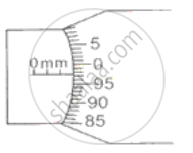
In the following figure, the pitch of the screw is 1 mm. Calculate:
(i) the least count of screw gauge and
(ii) the reading represented in the figure.
Name the measuring employed to measure the thickness of a paper.
Consider the following case where the zero of vernier scale and the zero of the main scale are clearly seen. If L.C. of the vernier calipers is 0.01 cm, write the zero error and zero correction of the following.