Advertisements
Advertisements
Question
When a piece of limestone reacts with dilute HCl, a gas X is produced. When gas X is passed through lime water then a white precipitate Y is formed. On passing excess of gas X, the white precipitate dissolves forming a soluble compound Z.
- What are X, Y and Z?
- Write equations for the reactions which take place:
- When limestone reacts with dilute HCl.
- When gas X reacts with lime water to form white precipitate Y.
- When excess of gas X dissolves white precipitate Y to form a soluble compound Z.
Advertisements
Solution
- X is carbon dioxide gas (CO2).
Y is calcium carbonate (CaCO3).
Z is calcium hydrogen carbonate (calcium bicarbonate) (Ca(HCO3)2). -
- When a piece of limestone or calcium carbonate is treated with dilute hydrochloric acid, carbon dioxide gas (CO2, here given as X) is produced.
\[\ce{CaCO3_{(s)} + 2HCl_{(aq)} -> CaCl2_{(aq)} + H2O_{(l)} + CO2_{(g)}}\] - When carbon dioxide (X), liberated in the reaction, is passed through lime water, the lime water turns milky or a white precipitate of calcium carbonate (CaCO3, here given as Y) is formed.
\[\ce{Ca(OH)2_{(aq)} + CO2_{(g)} -> CaCO3_{(s)} + H2O_{(l)}}\] - When an excess of carbon dioxide is passed through lime water, a solution of calcium hydrogen carbonate [Z, Ca(HCO3)2] is formed.
\[\ce{CaCO3_{(s)} + H2O_{(l)} + CO2_{(g)} -> Ca(HCO3)2_{(aq)}}\]
- When a piece of limestone or calcium carbonate is treated with dilute hydrochloric acid, carbon dioxide gas (CO2, here given as X) is produced.
APPEARS IN
RELATED QUESTIONS
A solution turns red litmus blue. Its pH is likely to be ______.
Name an indicator which is pink in alkaline solution but turns colourless in acidic solution.
Give two examples of organic acids.
A white shirt has a yellow stain of curry. When soap is rubbed on this shirt during washing, the yellow stain turns reddish-brown. On rinsing the shirt with plenty of water, the reddish-brown stain turns yellow again.
- Name the natural indicator present in curry stain.
- Explain the changes in colour of this indicator which take place during washing and rinsing the shirt.
- What is the nature of soap (acidic/basic) as shown by the indicator present in curry stain?
What happens to the H+ ions, of the solution, when an acid is neutralised?
Which chemical is injected into the skin of a person during an ant’s sting?
How can the effect of these stings be neutralised?
Which acid is produced in our stomach? What happens if there is an excess of acid in the stomach? How can its effect be cured?
Name an acid used to flavor and preserve food.
Name an acid used to remove ink spots.
what effect does the concentration of [H3O+] ion have on solution?
Do basic solutions also have H+(aq)? Why are they basic?
Which gas is usually liberated when an acid reacts with a metal? Illustrate with an example. How will you test for the presence of this gas?
Define an acid.
Explain, all alkalis are bases but all bases are not alkalis.
Carbonic acid gives an acid salt but hydrochloric acid does not. Explain.
Choose the correct answer from the options given below:
Benzoic acid is used for/in/as
HCl, HNO3, C2H5OH, C6H12O6 all contain H atoms but only HCl and HNO3 show acidic character. Why?
Fill in the cross word given in figure with the help of the clues provided.
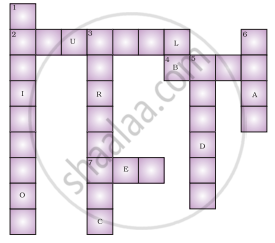
Across
(2) The solution which does not change the colour of either red or blue litmus.
(4) Phenolphthalein gives pink colour in this type of solution.
(7) Colour of blue litmus in lemon juice.
Down
(1) It is used to test whether a substance is acidic or basic.
(3) It is a natural indicator and gives pink colour in basic solution.
(5) Nature of ant’s sting.
(6) It is responsible for the increase in temperature during a neutralisation reaction.
A metal 'M' on reacting with dilute acid liberates a gas 'G'. The same metal also liberates gas 'G' when reacts with a base.
- Write the name of gas 'G'.
- How will you test the presence of this gas?
- Write chemical equations for the reactions of the metal with (1) an acid and (2) a base.
Exlain the following:
\[\ce{H3PO3}\] is not tribasic acid.
