Advertisements
Advertisements
प्रश्न
When a piece of limestone reacts with dilute HCl, a gas X is produced. When gas X is passed through lime water then a white precipitate Y is formed. On passing excess of gas X, the white precipitate dissolves forming a soluble compound Z.
- What are X, Y and Z?
- Write equations for the reactions which take place:
- When limestone reacts with dilute HCl.
- When gas X reacts with lime water to form white precipitate Y.
- When excess of gas X dissolves white precipitate Y to form a soluble compound Z.
Advertisements
उत्तर
- X is carbon dioxide gas (CO2).
Y is calcium carbonate (CaCO3).
Z is calcium hydrogen carbonate (calcium bicarbonate) (Ca(HCO3)2). -
- When a piece of limestone or calcium carbonate is treated with dilute hydrochloric acid, carbon dioxide gas (CO2, here given as X) is produced.
\[\ce{CaCO3_{(s)} + 2HCl_{(aq)} -> CaCl2_{(aq)} + H2O_{(l)} + CO2_{(g)}}\] - When carbon dioxide (X), liberated in the reaction, is passed through lime water, the lime water turns milky or a white precipitate of calcium carbonate (CaCO3, here given as Y) is formed.
\[\ce{Ca(OH)2_{(aq)} + CO2_{(g)} -> CaCO3_{(s)} + H2O_{(l)}}\] - When an excess of carbon dioxide is passed through lime water, a solution of calcium hydrogen carbonate [Z, Ca(HCO3)2] is formed.
\[\ce{CaCO3_{(s)} + H2O_{(l)} + CO2_{(g)} -> Ca(HCO3)2_{(aq)}}\]
- When a piece of limestone or calcium carbonate is treated with dilute hydrochloric acid, carbon dioxide gas (CO2, here given as X) is produced.
APPEARS IN
संबंधित प्रश्न
Name an indicator which is pink in alkaline solution but turns colourless in acidic solution.
Which gas is usually liberated when an acid reacts with a metal? How will you test for the presence of this gas?
What are organic acids?
Give two examples of organic acids.
State some of the uses of mineral acids in industry.
What is meant by strong acids?
What colour does phenolphthalein indicator turn when added to an alkali (such as sodium hydroxide)?
What happens during a bee sting? What is its remedy?
Give the names and formulae of two strong bases.
What happens when bases react with non-metal oxides? Explain with the help of an example. What does this reaction tell us about the nature of non-metal oxides?
Give two examples of the following:
monobasic acid
Do basic solutions also have H+(aq)? Why are they basic?
Out of HCl and CH3COOH, which one is a weak acid and why? Describe an activity to support your answer.
Give four examples of preparation of acids by synthesis.
The word sour refers to ______ in Latin.
An aqueous solution turns red litmus solution blue. Excess addition of which of the following solutions would reverse the change?
Match the chemical substances given in Column (A) with their appropriate application given in Column (B)
| Column (A) |
Column (B) |
| (A) Bleaching powder | (i) Preparation of glass |
| (B) Baking soda | (ii) Production of H2 and Cl2 |
| (C) Washing Soda | (iii) Decolourisation |
| (D) Sodium chloride | (iv) Antacid |
Fill in the cross word given in figure with the help of the clues provided.
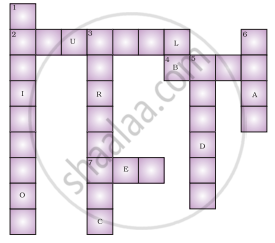
Across
(2) The solution which does not change the colour of either red or blue litmus.
(4) Phenolphthalein gives pink colour in this type of solution.
(7) Colour of blue litmus in lemon juice.
Down
(1) It is used to test whether a substance is acidic or basic.
(3) It is a natural indicator and gives pink colour in basic solution.
(5) Nature of ant’s sting.
(6) It is responsible for the increase in temperature during a neutralisation reaction.
You are supplied with five solutions: A, B, C, D and E with pH values as follows: A = 1.8, B = 7, C = 8.5, D = 13, and E = 5
Classify these solutions as neutral, slightly or strongly acidic and slightly or strongly alkaline.
Which solution would be most likely to liberate hydrogen with powdered zinc metal. Give a word equation for each reaction.
Which one of the following will not produce an acid when made to react with water.
