Advertisements
Advertisements
Question
What was the happiest time of the day for grandmother?
Advertisements
Solution
Half an hour in the afternoon, grandma devoted her time to feeding sparrows. That half-an-hour was the happiest time of the day for grandmother.
APPEARS IN
RELATED QUESTIONS
Fill in the blank with the suitable word.
To every one’s surprise, he turned _____________ at the party.
Explain how diction is important in the poem with the help of an example.
Explain the expression, ‘wonder-waiting eyes.’
Identify examples of the following devices in the poem: alliteration, personification, rhyme, rhythm. How do these devices contribute to the overall effect of the poem?
The caged bird sings with
A fearful trill of things unknown
But longed for still and his
Tune is heard on the distant hill
For the caged bird sings of freedom.
Read the above lines and answer the question that follow.
Explain, ‘stands on the grave of dreams / his shadow shouts on a nightmare scream’.
It was roses, roses, all the way,
With myrtle mixed in my path like mad;
The house-roofs seemed to heave and sway,
The church-spires flamed, such flags they had,
A year ago on this very day.
Read the above lines and answer the question that follow.
Explain with reference to the context.
Thus I entered, and thus I go!
In triumphs, people have dropped down dead,
"Paid by the world, what dost thou owe
Me?"....God might question; now instead,
'Tis God shall repay: I am safer so.
Read the above lines and answer the question that follow.
What does the rain imagery signify?
Fill in the blank with an appropriate word:
Air pollution is responsible for the spread ……… bronchitis.
Does Frank seem to encourage Taplow's comments on Crocker-Harris?
Distinguish between the following pairs of sentences.
Green stripes could be used or alternatively black ones.
Locate instances of irony in the story.
Suppose you are Rasheed. Describe in your own words your visit to the fair. Do not refer to the Lucky Shop.
Complete the following web diagram.

Visit a library. Find a school poem. Recite it to your parents.
Write down the consequences of the following occurrences with the help of the play.
Dr. Thomas Stockmann wants an article exposing social evils to be printed in the newspaper.
Give, in your own words, TWO reasons for the following:
The woman was reluctant to cross the street by herself.
Give, in your own words, TWO reasons for each of the following :
We must help those who are in need.
Answer the following question :
Is the influence of foreign customs always beneficial?
Prepare a set of questions to interview:
a person who has recently scaled Mt. Everest.
Your friend has presented a beautiful art piece on your birthday. Write a letter to her appreciating her art work.
Arrange the picture in order by writing the numbers 1,2,3 and 4 in the given boxes and write this familiar story in about 100 words.
Make use of the words given below.
| thirsty, village, pitcher, disappointment, pebbles, water level |
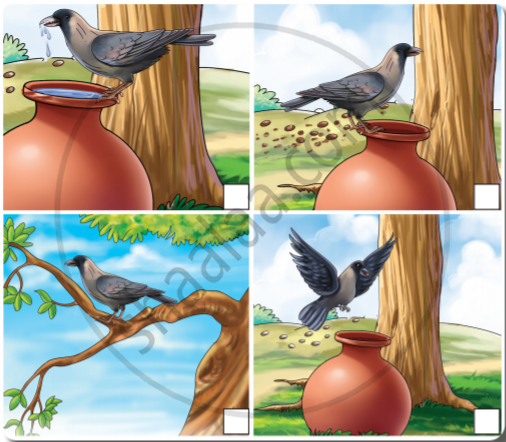
One hot day, a thirsty crow _____________________________________________________________
__________________________________________________________________________________________
Read the jumbled lines from the poem and rearrange them in correct order.
| 1. cinnamon, betel leaves |
| 2. and ginger and garlic” |
| 3. Go to Muthu’s |
| 4. My mother would say: |
| 5. and get some |
| 6. “Little boy Raj… |
| 7. And so I go to the shops |
| 8. singing all the way |
| 9. tomatoes and pickles” |
| 10. “Sesame seeds, onions |
| 11. I rattle off a list: |
| 12. what I’d want |
| 13. and when Muthu asks me |
| 14. my mother twists my ear |
| 15. and back home |
| 16. ouch! |
Narrate an incident when you have experienced happiness, excitement, surprise. You can use the following clues.
With whom...
When did it happen...
Why...
Where...
This is a picture of Rahul Gupta. Using the clues given, write a paragraph about him in your notebook.

|
Clues Indian, cricket, eight hours, practises, eats healthy food, runs two kilometres every day, batsman |
Who do you think is the naughtiest child in your class? Describe her/him in five lines.
Which do you think would be more fun — travelling by aeroplane or sailing on a ship? Write why you think so.
What did she consider her greatest achievement? Why?
Explain the following phrase selected from the story in your own word and work with a partner to make sentence using these phrase:
on approval
How does the play ‘The Never – Never Nest’ expose the harsh reality of modern living?
Study the picture given below. Write a story or a description or an account of what it suggests to you. Your composition may be about the subject of the picture, or you may take suggestions from it; however, there must be a clear connection between the picture and your composition.

