English

What Should Be Subtracted to the Polynomial X2 − 16x + 30, So that 15 is the Zero of the Resulting Polynomial? - Mathematics

Advertisements
Advertisements

Question

What should be subtracted to the polynomial x2 − 16x + 30, so that 15 is the zero of the resulting polynomial?

Options

  • 30

  • 14

  • 15

  • 16

MCQ
Advertisements

Solution

We know that, if `x = alpha`, is zero of a polynomial then `x-alpha` is a factor of  f(x)

Since 15 is zero of the polynomial (x) = x2 − 16x + 30, therefore (x − 15) is a factor of f (x)

Now, we divide  f(x) = x2 − 16x + 30 by  ( x - 15) we get
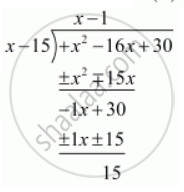
Thus we should subtract the remainder  15 from `x^2 - 16x+30`

Hence, the correct choice is (c).

shaalaa.com
  Is there an error in this question or solution?
Chapter 2: Polynomials - Exercise 2.5 [Page 64]

APPEARS IN

RD Sharma Mathematics [English] Class 10
Chapter 2 Polynomials
Exercise 2.5 | Q 25 | Page 64

RELATED QUESTIONS

Find the zeroes of the following quadratic polynomial and verify the relationship between the zeroes and the coefficients:

4s2 – 4s + 1


Find the zeroes of the following quadratic polynomial and verify the relationship between the zeroes and the coefficients.

6x2 – 3 – 7x


Find the zeroes of the following quadratic polynomial and verify the relationship between the zeroes and the coefficients.

4u2 + 8u


Find all zeroes of the polynomial `(2x^4 - 9x^3 + 5x^2 + 3x - 1)` if two of its zeroes are `(2 + sqrt3)`  and `(2 - sqrt3)`


If α and β are the zeros of the quadratic polynomial f(x) = ax2 + bx + c, then evaluate `1/alpha+1/beta-2alphabeta`


If α and β are the zeros of the quadratic polynomial p(s) = 3s2 − 6s + 4, find the value of `alpha/beta+beta/alpha+2[1/alpha+1/beta]+3alphabeta`


Find the zeroes of the quadratic polynomial `2x^2 ˗ 11x + 15` and verify the relation between the zeroes and the coefficients. 


Find the zeroes of the quadratic polynomial` (x^2 ˗ 5)` and verify the relation between the zeroes and the coefficients.


Find a cubic polynomial whose zeroes are 2, -3and 4. 


By actual division, show that x2 – 3 is a factor of` 2x^4 + 3x^3 – 2x^2 – 9x – 12.` 


If α, β, γ are the zeros of the polynomial f(x) = ax3 + bx2 cx + d, then α2 + β2 + γ2 =


If α, β, γ are are the zeros of the polynomial f(x) = x3 − px2 + qx − r, the\[\frac{1}{\alpha\beta} + \frac{1}{\beta\gamma} + \frac{1}{\gamma\alpha} =\]


Check whether g(x) is a factor of p(x) by dividing polynomial p(x) by polynomial g(x),
where p(x) = x5 − 4x3 + x2 + 3x +1, g(x) = x3 − 3x + 1


Zeroes of a polynomial can be determined graphically. No. of zeroes of a polynomial is equal to no. of points where the graph of polynomial ______.


Find the zeroes of the following polynomials by factorisation method and verify the relations between the zeroes and the coefficients of the polynomials:

`4x^2 + 5sqrt(2)x - 3`


For the following, find a quadratic polynomial whose sum and product respectively of the zeroes are as given. Also find the zeroes of these polynomials by factorisation.

`(-8)/3, 4/3`


Find the zeroes of the following polynomials by factorisation method and verify the relations between the zeroes and the coefficients of the polynomials:

`7y^2 - 11/3 y - 2/3`


Find the sum and product of the roots of the quadratic equation 2x2 – 9x + 4 = 0.


If α, β are the zeroes of the polynomial p(x) = 4x2 – 3x – 7, then `(1/α + 1/β)` is equal to ______.


The zeroes of the polynomial p(x) = 2x2 – x – 3 are ______.


Share
Notifications

Englishहिंदीमराठी


      Forgot password?
Use app×