Advertisements
Advertisements
प्रश्न
What should be subtracted to the polynomial x2 − 16x + 30, so that 15 is the zero of the resulting polynomial?
पर्याय
30
14
15
16
Advertisements
उत्तर
We know that, if `x = alpha`, is zero of a polynomial then `x-alpha` is a factor of f(x)
Since 15 is zero of the polynomial f (x) = x2 − 16x + 30, therefore (x − 15) is a factor of f (x)
Now, we divide f(x) = x2 − 16x + 30 by ( x - 15) we get
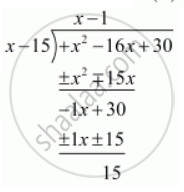
Thus we should subtract the remainder 15 from `x^2 - 16x+30`
Hence, the correct choice is (c).
APPEARS IN
संबंधित प्रश्न
Find the zeros of the quadratic polynomial 6x2 - 13x + 6 and verify the relation between the zero and its coefficients.
Find the zeroes of the following quadratic polynomial and verify the relationship between the zeroes and the coefficients:
t2 – 15
If a and are the zeros of the quadratic polynomial f(x) = 𝑥2 − 𝑥 − 4, find the value of `1/alpha+1/beta-alphabeta`
If a and 3 are the zeros of the quadratic polynomial f(x) = x2 + x − 2, find the value of `1/alpha-1/beta`.
If 𝛼 and 𝛽 are the zeros of the quadratic polynomial f(x) = x2 − 5x + 4, find the value of `1/alpha+1/beta-2alphabeta`
If α and β are the zeros of the quadratic polynomial f(t) = t2 − 4t + 3, find the value of α4β3 + α3β4.
If α and β are the zeros of the quadratic polynomial p(s) = 3s2 − 6s + 4, find the value of `alpha/beta+beta/alpha+2[1/alpha+1/beta]+3alphabeta`
If the sum of the zeros of the quadratic polynomial f(t) = kt2 + 2t + 3k is equal to their product, find the value of k.
If α and β are the zeros of the quadratic polynomial f(x) = x2 − 3x − 2, find a quadratic polynomial whose zeroes are `1/(2alpha+beta)+1/(2beta+alpha)`
Find the zeroes of the quadratic polynomial `2x^2 ˗ 11x + 15` and verify the relation between the zeroes and the coefficients.
Find the zeroes of the quadratic polynomial` (x^2 ˗ 5)` and verify the relation between the zeroes and the coefficients.
Find the zeroes of the quadratic polynomial `(5y^2 + 10y)` and verify the relation between the zeroes and the coefficients.
Find the quadratic polynomial whose zeroes are `2/3` and `-1/4` Verify the relation between the coefficients and the zeroes of the polynomial.
Find the quadratic polynomial, sum of whose zeroes is 0 and their product is -1. Hence, find the zeroes of the polynomial.
If two zeroes of the polynomial x3 + x2 − 9x − 9 are 3 and −3, then its third zero is
If x + 2 is a factor of x2 + ax + 2b and a + b = 4, then
The below picture are few natural examples of parabolic shape which is represented by a quadratic polynomial. A parabolic arch is an arch in the shape of a parabola. In structures, their curve represents an efficient method of load, and so can be found in bridges and in architecture in a variety of forms.


If the sum of the roots is –p and the product of the roots is `-1/"p"`, then the quadratic polynomial is:
If two of the zeroes of a cubic polynomial are zero, then it does not have linear and constant terms.
Find the zeroes of the following polynomials by factorisation method and verify the relations between the zeroes and the coefficients of the polynomials:
t3 – 2t2 – 15t
For the following, find a quadratic polynomial whose sum and product respectively of the zeroes are as given. Also find the zeroes of these polynomials by factorisation.
`-2sqrt(3), -9`
