Advertisements
Advertisements
प्रश्न
Find the zeroes of the following quadratic polynomial and verify the relationship between the zeroes and the coefficients:
3x2 – x – 4
Advertisements
उत्तर
3x2 – x – 4
= 3x2 – 4x + 3x – 4
= x(3x – 4) + 1(3x - 4)
= (3x – 4)(x + 1)
For p(x) = 0 we have,
Either (x + 1) = 0
x = –1
or 3x – 4 = 0
`x = 4/3`
∴ The zeroes of 3x2 - x - 4 are -1 and `4/3`
Now,
Sum of the zeroes = `-("Coefficient of " x)/("Coefficient of " x^2)`
= `(-1) + 4/3`
= `(-(-1))/3`
= `1/3 = 1/3`
and product of zeroes `"Constant term"/("Coefficient of " x^2)`
`(-1)xx 4/3 = (-4)/3`
= `(-4)/3 = (-4)/3`
Thus, the relationship between the zeroes and coefficients in the polynomial 3x2 – x – 4 is verified.
APPEARS IN
संबंधित प्रश्न
Find the zeros of the quadratic polynomial 6x2 - 13x + 6 and verify the relation between the zero and its coefficients.
Find the zeroes of the following quadratic polynomial and verify the relationship between the zeroes and the coefficients:
x2 – 2x – 8
Find a quadratic polynomial with the given numbers as the sum and product of its zeroes, respectively.
`sqrt2 , 1/3`
Find the zeroes of the following quadratic polynomials and verify the relationship between the zeroes and the coefficients
`f(x)=x^2-(sqrt3+1)x+sqrt3`
If α and β are the zeros of the quadratic polynomial f(x) = ax2 + bx + c, then evaluate α2β + αβ2
If If α and β are the zeros of the quadratic polynomial f(x) = x2 – 2x + 3, find a polynomial whose roots are α + 2, β + 2.
Find the quadratic polynomial, sum of whose zeroes is 0 and their product is -1. Hence, find the zeroes of the polynomial.
Verify that 3, –2, 1 are the zeros of the cubic polynomial p(x) = (x3 – 2x2 – 5x + 6) and verify the relation between it zeros and coefficients.
By actual division, show that x2 – 3 is a factor of 2x4 + 3x3 – 2x2 – 9x – 12.
If 3 and –3 are two zeroes of the polynomial (x4 + x3 – 11x2 – 9x + 18), find all the zeroes of the given polynomial.
If α, β are the zeroes of the polynomial f(x) = 5x2 – 7x + 1 then `1/α + 1/β = ?`
The below picture are few natural examples of parabolic shape which is represented by a quadratic polynomial. A parabolic arch is an arch in the shape of a parabola. In structures, their curve represents an efficient method of load, and so can be found in bridges and in architecture in a variety of forms.


If the sum of the roots is –p and the product of the roots is `-1/"p"`, then the quadratic polynomial is:
Basketball and soccer are played with a spherical ball. Even though an athlete dribbles the ball in both sports, a basketball player uses his hands and a soccer player uses his feet. Usually, soccer is played outdoors on a large field and basketball is played indoor on a court made out of wood. The projectile (path traced) of soccer ball and basketball are in the form of parabola representing quadratic polynomial.

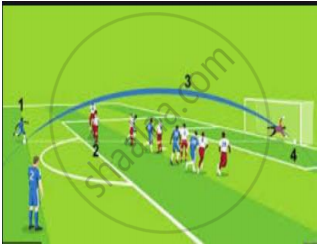
What will be the expression of the polynomial?
If all three zeroes of a cubic polynomial x3 + ax2 – bx + c are positive, then at least one of a, b and c is non-negative.
Find the zeroes of the following polynomials by factorisation method and verify the relations between the zeroes and the coefficients of the polynomials:
3x2 + 4x – 4
Find the zeroes of the following polynomials by factorisation method and verify the relations between the zeroes and the coefficients of the polynomials:
`v^2 + 4sqrt(3)v - 15`
If p(x) = x2 + 5x + 6, then p(– 2) is ______.
Find the zeroes of the quadratic polynomial x2 + 6x + 8 and verify the relationship between the zeroes and the coefficients.
For the cubic equation \[ ax^{3} + bx^{2} + cx + d = 0 \] with roots \[ \alpha, \beta, \gamma \], the sum of the roots \( \alpha + \beta + \gamma \) is:
For the cubic equation \[ ax^{3} + bx^{2} + cx + d = 0 \] with roots \[ \alpha, \beta, \gamma \], the pairwise product \( \alpha\beta + \beta\gamma + \gamma\alpha \) equals:
