Advertisements
Advertisements
Question
What should be added to the polynomial x2 − 5x + 4, so that 3 is the zero of the resulting polynomial?
Options
1
2
4
5
Advertisements
Solution
If `x = alpha`, is a zero of a polynomial then `x -alpha `is a factor of `f(x)`
Since 3 is the zero of the polynomial , f(x) = x2 − 5x + 4,
Therefore `x - 3`is a factor of `f(x)`
Now, we divide`f(x) = x^2 - 5x + 4 ` by `(x - 3)` we get
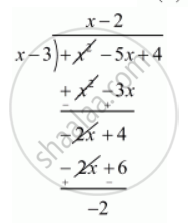
Therefore we should add 2 to the given polynomial
Hence, the correct choice is (b).
APPEARS IN
RELATED QUESTIONS
Find the zeros of the quadratic polynomial 6x2 - 13x + 6 and verify the relation between the zero and its coefficients.
Find the zeroes of the following quadratic polynomial and verify the relationship between the zeroes and the coefficients:
3x2 – x – 4
Find all zeroes of the polynomial `(2x^4 - 9x^3 + 5x^2 + 3x - 1)` if two of its zeroes are `(2 + sqrt3)` and `(2 - sqrt3)`
If α and β are the zeros of the quadratic polynomial p(s) = 3s2 − 6s + 4, find the value of `alpha/beta+beta/alpha+2[1/alpha+1/beta]+3alphabeta`
If α and β are the zeros of the quadratic polynomial f(x) = x2 − 3x − 2, find a quadratic polynomial whose zeroes are `1/(2alpha+beta)+1/(2beta+alpha)`
If α and β are the zeros of a quadratic polynomial such that α + β = 24 and α − β = 8, find a quadratic polynomial having α and β as its zeros.
If If α and β are the zeros of the quadratic polynomial f(x) = x2 – 2x + 3, find a polynomial whose roots are α + 2, β + 2.
If If α and β are the zeros of the quadratic polynomial f(x) = x2 – 2x + 3, find a polynomial whose roots are `(alpha-1)/(alpha+1)` , `(beta-1)/(beta+1)`
Find the zeroes of the polynomial f(x) = `2sqrt3x^2-5x+sqrt3` and verify the relation between its zeroes and coefficients.
Find the zeroes of the quadratic polynomial `(3x^2 ˗ x ˗ 4)` and verify the relation between the zeroes and the coefficients.
Find the quadratic polynomial, sum of whose zeroes is 8 and their product is 12. Hence, find the zeroes of the polynomial.
Verify that 5, -2 and 13 are the zeroes of the cubic polynomial `p(x) = (3x^3 – 10x^2 – 27x + 10)` and verify the relation between its zeroes and coefficients.
If 2 and `1/2` are the zeros of px2 + 5x + r, then ______.
Given that one of the zeroes of the cubic polynomial ax3 + bx2 + cx + d is zero, the product of the other two zeroes is ______.
If the zeroes of a quadratic polynomial ax2 + bx + c are both positive, then a, b and c all have the same sign.
If all the zeroes of a cubic polynomial are negative, then all the coefficients and the constant term of the polynomial have the same sign.
For the following, find a quadratic polynomial whose sum and product respectively of the zeroes are as given. Also find the zeroes of these polynomials by factorisation.
`-2sqrt(3), -9`
For the following, find a quadratic polynomial whose sum and product respectively of the zeroes are as given. Also find the zeroes of these polynomials by factorisation.
`(-3)/(2sqrt(5)), -1/2`
Find the zeroes of the following polynomials by factorisation method and verify the relations between the zeroes and the coefficients of the polynomials:
`7y^2 - 11/3 y - 2/3`
The zeroes of the polynomial p(x) = 25x2 – 49 are ______.
