Advertisements
Advertisements
Question
What is seed? What are the parts of a seed? Explain with the help of a labelled diagram.
Advertisements
Solution
Seed is the reproductive unit of a plant. The various parts of a seed are plumule, radicle and cotyledon.

APPEARS IN
RELATED QUESTIONS
Name the parts A, B and C shown in the following diagram and state one function of each.

How is the process of pollination different from fertilization?
Explain what you understand by sexual reproduction.
State the name of the functional unit concerned with sexual reproduction.
Fill in the following blank with suitable word :
The ovule becomes a .......... after fertilisation.
Draw a neat sketch of the carpel of a flower. Mark in it stigma, style and ovary.
In tobacco plant, the male gametes have 24 chromosomes.
What is the number of chromosomes in the female gamete?
Identify A, B, C and D in the given diagram and write their names.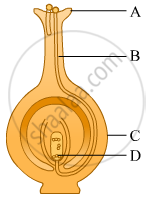
Find the odd one out:
Bisexual : Hibiscus : : Unisexual : ___________
Match the following
| 1. | Petal | Opuntia |
| 2. | Fern | Chrysanthemum |
| 3. | Phylloclade | Attracts insect |
| 4. | Hooks | Spore |
| 5. | Sucker | Bignonia |
The essential parts of a flower are ______.
Gloriosa superba exhibits ______.
Conidia are formed endogenously while zoospores are formed endogenously.
The flower of the Hibiscus plant is ______
Which out of the following processes does not lead to the formation of clones.
Complete the table
| Carly x | ______ | ______ |
| ______ | petal | attract insects |
| Androecium | ______ | Male reproductive part |
| ______ | ______ | Female reproductive part. |
In flowering plants, the pollen grains are transferred to stigma by pollination but the female germ cells are present in the ovary.
Explain with the help of a labelled diagram (only concerned parts), how the male germ cell reaches the ovary.
Explain the post fertilization changes that occur in the ovary of a flower.
State the post-fertilisation changes that lead to fruit formation in plants.
