Advertisements
Advertisements
Questions
What is the water potential?
Explain the term:
Water potential
Advertisements
Solution
Water potential is the measure of the tendency of water to move from one region to another, usually from an area of higher water potential to a lower water potential. It indicates the free energy of water in a system.
It is represented by the Greek letter psi (ψ). The unit of measurement of water potential is bars/pascals/atmospheres.
RELATED QUESTIONS
Differentiate between the following on the basis of what is indicated in the bracket.
Hypotonic solution and Hypertonic solution (condition of a plant cell when placed in them).
Name the following:
The condition of a cell placed in a hypotonic solution.
Give the equivalent terms for the following:
Pressure of the cell contents on the cell wall
(a) Mention whether the following statement is true (True) or false (False)
(b) Correct the false statement by altering the last word only.
A plant cell placed in hypotonic solution gets Plasmolysed.
The diagram given below represents an experimental set-up to demonstrate a certain process. Study the same and answer the questions that follow:
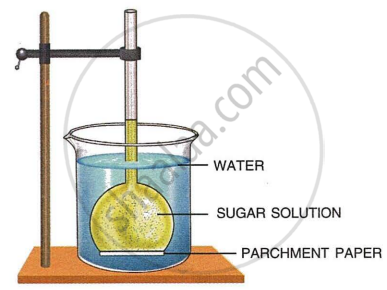
- Name the process.
- Define the above-named process.
- What would you observe in the experimental set-up after an hour or so?
- What control experiment can be set up for comparison?
- Keeping in mind the root hair, cell and its surroundings, name the parts that correspond to
- concentrated sugar solution
- parchment paper
- water in the beaker
- Name any other material that can be used instead of parchment paper in the above experiment.
- Mention two advantages of the process for the plants.
Define the following:
Hypertonic solution
Name the following:
Condition of cell in which the cell contents are shrunken.
Explain why:
We gargle with saline solution in case of throat infection.
Choose the correct answer:
Grapes when placed in a strong sugar solution shrink because of __________
What do you mean by transpiration pull ?
Give Reasons for the following.
It is necessary to maintain a normal osmotic concentration of the blood.
Differentiate between the following
Endosmosis and Exosmosis
The beaker is divided into two chambers A and B. The big circle represents solute and the small circles solvent.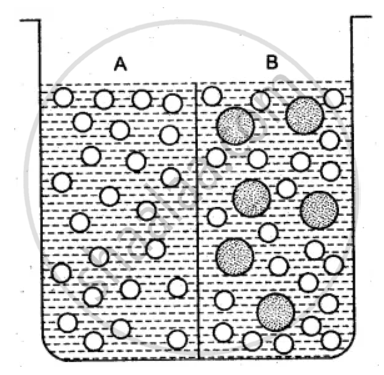
(i) What can you say about the size of the holes in the membrane, if it is to behave semi- permeably between these two?
(ii) Will the solvent molecules pass through the membrane from left to right, from right to left, in either direction or in both directions?
(iii) In which direction will there be a net movement of solvent molecules?
Name the following:
Name the process by which water enters the root hair cell.
Name the following:
The process by which raisins swell up when placed in a beaker of water.
Mention, if the following statement is True or False. If false rewrite the wrong statement in its correct form:
Plasmolysis makes the cell turgid.
Explain the Term:
Osmosis
During a practical exam, a plant cell in a particular solution was placed under a compound microscope. Students were told to observe the cell and name the tonicity of the solution and mention the process that occurred in the cell.
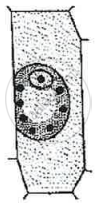
When a cell in solution shrinks and loses its shape, then the solution is ______.
