Advertisements
Advertisements
Question
Draw the structure of the following atoms showing the nucleus containing – protons, neutrons and the orbits with the respective electron:
Sodium [At. no. = 11, Mass no. = 23]
Advertisements
Solution
Structure of atoms:
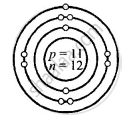
Z is Atomic Number and A is the mass number
Sodium \[\ce{^23_11Na}\]
Z = 11 = p = e
K L M
e = 11 = 2, 8, 1
A = p + n
23 = 11 + n
∴ n = 23 − 11 = 12
APPEARS IN
RELATED QUESTIONS
Multiple Choice Questions
If the atomic number of an atom is 17 and mass number is 35 then number of neutron will be
(a) Which of the nuclear particles is present in the same fixed number in the atoms of any particular element?
(b) What do we call this number which is characteristic of a particular element?
Draw the orbital diagram of `""_20^40"Ca"^(2+)` ion and state the number of three fundamental particles present in it.
Match the atomic numbers 4,8,10,15 and 19 with the following:
Element with four shells
Elements X, Y and Z have atomic numbers 6,9 and 12 respectively. Which one:
- Forms an anion
- Forms a cation
State why the atomic weight of an element is also termed relative atomic mass.
Draw the structure of the following atoms showing the nucleus containing – protons, neutrons and the orbits with the respective electron:
Isotopes of hydrogen [11H, 21H, 31H]
The particles that make up the atom are called ______ particles.
A ______ number describes a specific aspect of an electron.
What is the relation between mass number & atomic number?
