Advertisements
Advertisements
Question
Advertisements
Solution
APPEARS IN
RELATED QUESTIONS
If the charge on an electron is 1.6 × 10⁻¹⁹ coulombs, how many electrons should pass through a conductor in 1 second to constitute 1 ampere current?
Which unit could be used to measure current?
(a) Watt
(b) Coulomb
(c) Volt
(d) Ampere
An electric bulb of resistance 20 Ω and a resistance wire of 4 Ω are connected in series with a 6 V battery.
Draw the circuit diagram, and calculate:
(a) total resistance of the circuit.
(b) current through the circuit.
(c) potential difference across the electric bulb.
(d) potential difference across the resistance wire.
If you were going to connect two light bulbs to one battery, would you use a series or a parallel arrangement? Why? Which arrangement takes more current from the battery?
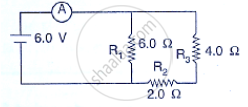
Three resistors of 6.0 𝛀, 2.0𝛀 and 4.0𝛀 are joined to an ammeter A and a cell of e.m.f. 6.0 V as
shown in fig 8.52 Calculate:
(a) the effective resistance of the circuit and
(b) the reading of ammeter.
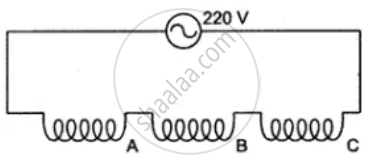
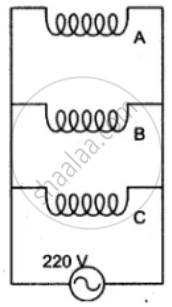
The diagram shows two ways of connecting three lamps P, Q and R to A.C. supply of 220 V.
A bulb marked 12 V, 24 W operates on a 12 V battery for 20 minutes. Calculate:
- The current flowing through it, and
- The energy consumed.
- What is meant by electric current?
- Name and define its unit.
- Which instrument is used to measure the electric current? How should it be connected in a circuit?
