Advertisements
Advertisements
Question
What do you know about complex tissue? Classify and explain its different types in plants with suitable diagrams.
Advertisements
Solution
Complex tissues:
The complex tissues consist of more than one type of cells having a common origin. These tissues are involved in transporting water, mineral salts (nutrients), and food materials to various parts of plant.
The complex tissues are of following two types:
1. Xylem:
It is a conducting tissue composed of cells of four different types—that is, tracheids, vessels, xylem parenchyma, and xylem fibre.Except xylem parenchyma, all other xylem components are dead and lignified. Tracheids and vessels are involved in the conduction of water. Xylem parenchyma stores food and helps in lateral conduction of water.

2. Phloem:
It is also a conducting tissue and consists of four elements—that is, sieve tubes, companion cells, phloem parenchyma, and phloem fibres.Except phloem fibres, all phloem elements are living. Sieve tubes and companion cells work as a single unit. Phloem transports (conducts) photosynthetically prepared food materials from the leaves to the storage organs and later from storage organs to the growing regions of the plant body.

APPEARS IN
RELATED QUESTIONS
How are simple tissues different from complex tissues in plants?
What is the role of epidermis in plants?
Draw a well labelled diagram of xylem.
Explain how sieve tubes manage to be living?
Parenchyma containing chloroplasts is known as :
Study the diagram given below and then answer the question that follows:
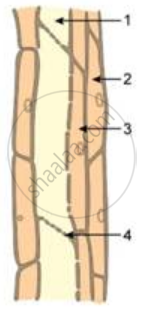
Name the parts labelled 1, 2, 3 and 4.
Study the diagram given below and then answer the question that follows:
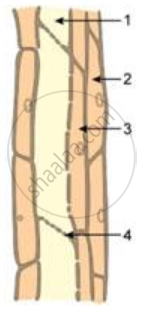
State the function of the parts labelled 1, 2, 3 and 4.
Write 'True or False' for the following statement:
A vascular bundle conducts prepared food only.
Choose the correct option.
Collenchyma is a type of ______ tissue.
In which of the following pairs of parts of a flowering plant is epidermis absent?
