Advertisements
Advertisements
Question
Why are xylem and phloem called complex tissues?
Advertisements
Solution 1
Xylem and phloem are known as complex tissues as they are made up of more than one type of cells. These cells work in a coordinated manner, as a unit, to perform the various functions of the xylem and phloem.
Xylem helps in conducting water and minerals. It also provides mechanical support to plants. It is made up of the following components:
Tracheids (xylem vessels and xylem tracheids)
Xylem parenchyma
Xylem fibres
Tracheids are elongated, thick-walled dead cells with tapering ends. Vessels are long, tubular, and cylindrical structures formed from the vessel members, with each having lignified walls and large central cavities. Both tracheids and vessels lack protoplasm. Xylem fibres consist of thick walls with an almost insignificant lumen. They help in providing mechanical support to the plant. Xylem parenchyma is made up of thin-walled parenchymatous cells that help in the storage of food materials and in the radial conduction of water.
Phloem helps in conducting food materials. It is composed of:
Sieve tube elements
Companion cells
Phloem parenchyma
Phloem fibres
Sieve tube elements are tube-like elongated structures associated with companion cells. The end walls of sieve tube elements are perforated to form the sieve plate. Sieve tube elements are living cells containing cytoplasm and nucleus. Companion cells are parenchymatous in nature. They help in maintaining the pressure gradient in the sieve tube elements. Phloem parenchyma helps in the storage of food and is made up of long tapering cells, with a dense cytoplasm. Phloem fibres are made up of elongated sclerenchymatous cells with thick cell walls.
Solution 2
A group of different types of cells which perform common function is called complex tissue. Xylem and phloem are called complex tissues as all cells that work as a unit for a common function have different structural organisation. Xylem has four types of cells-tracheids, vessels, xylem parenchyma and xylem fibres. Phloem consists of sieve tube elements, companion cells, phloem parenchyma and phloem fibres. Xylem is associated with conduction of water and minerals from roots to top of plants and phloem is responsible for transport of organic food.
RELATED QUESTIONS
What are the functions of the stomata?
What is the role of epidermis in plants?
What are simple tissues?
Draw a well labelled diagram of parenchyma.
Give two functions of collenchyma.
Explain different types of elements present in phloem.
Explain how sieve tubes manage to be living?
What is simple tissue? Classify and explain its different types with suitable diagram.
What is simple tissue? Classify and explain its different types with suitable diagram.
Parenchyma containing chloroplasts is known as :
Differentiate between cells of Parenchyma and Collenchyma.
Study the diagram given below and then answer the question that follows:
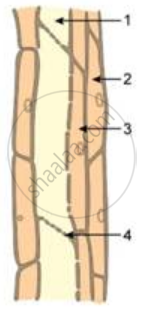
Name the parts labelled 1, 2, 3 and 4.
A permanent tissue is of how many types?
Differentiate between:
Parenchyma and collenchyma
Give the structure and function of the following:
Collenchyma
The question has four answers. Choose the correct answer:
Hard lignified thick walled, long and pointed cells in a plant are
The question has four answers. Choose the correct answer:
The parenchymatous tissue is
Explain sclereids with their types.
Name any two simple and two complex permanent tissues in plants.
