Advertisements
Advertisements
Question
What is simple tissue? Classify and explain its different types with suitable diagram.
Advertisements
Solution
Simple tissue:
These tissues are composed of structurally and functionally similar cells.
They are of three types.
(i) Parenchyma:
It is widely distributed in plant bodies such as stems, roots, leaves, flowers, and fruits. Its cells are isodiametric and contains live protoplasm. It serves as a food storage and packing tissue. It also stores waste products of plants.

(ii) Collenchyma:
It is located below the epidermis of dicot stem and petiole. It consists of living cells and is characterised by an extra deposition of cellulose at the corners. It is a mechanical tissue in young plants. It also provides elasticity to the plant, particularly stem of dicots.


(iii) Sclerenchyma:
It consist of dead lignified cells. It has two types of cells—that is, fibres and sclereids. It occurs in abundance or in patches in definite layers in stems, roots, veins of leaves, hard covering of seeds, and nuts. It provides mechanical support to the plant.

APPEARS IN
RELATED QUESTIONS
What are different types of tissues in plants? Describe simple tissues.
Parenchyma containing chloroplasts is known as :
Differentiate between cells of Meristematic tissue and Permanent tissue
Study the diagram given below and then answer the question that follows:
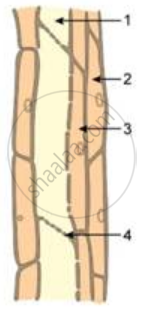
Name the parts labelled 1, 2, 3 and 4.
Give the structure and function of the following:
Collenchyma
Give the structure and function of the following:
Phloem
Name the tissue associated with the following:
Conduction of water in the plant body.
The question has four answers. Choose the correct answer:
Phloem parenchyma, sclerenchyma, sieve tubes, and companion cells are found in
Match the column (A) with the column (B)
| (A) | (B) | ||
| (a) | Parenchyma | (i) | Thin walled, packing cells |
| (b) | Photosynthesis | (ii) | Carbon fixation |
| (c) | Aerenchyma | (iii) | Localized thickenings |
| (d) | Collenchyma | (iv) | Buoyancy |
| (e) | Permanent tissue | (v) | Sclerenchyma |
Differentiate fibers from sclereids.
