Advertisements
Advertisements
Question
Distinguish between xylem and phloem.
Distinguish Between
Advertisements
Solution
| Xylem | Phloem |
| 1. It conducts water and minerals. | 1. It conducts organic solutes or food materials. |
| 2. Conduction is mostlyunidirectional, i.e., from roots to apical parts of the plant. | 2. In it conduction may be bidirectional, i.e., from leaves to storage organs or growing parts or from storage organs to growing parts of plants. |
| 3. Conducting channels or tracheary elements are tracheids and vessels. | 3. Conducting channels are sieve tubes. |
| 4. Components of xylem include tracheids, vessels, xylem parenchyma and xylem fibres. | 4. Components of phloem include sieve tubes, companion cells, phloem parenchyma and phloem fibres. |
| 5. Three of the four elements of xylem are dead (i.e., tracheids, vessels and fibres). Only xylem parenchyma is living. | 5. Three of four elements are living (i.e., sieve tubes, companion cells and phloem parenchyma) only phloem fibres are dead. |
| 6. In addition to conduction, xylem provides mechanical strength to the plant. | 6. Phloem performs no mechanical function for the plants. |
shaalaa.com
Is there an error in this question or solution?
APPEARS IN
RELATED QUESTIONS
How are simple tissues different from complex tissues in plants?
How does the cork act as a protective tissue?
Complete the following chart:

What is the differences between collenchyma and sclerenchyma?
Study the diagram given below and then answer the question that follows:
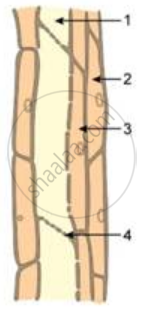
Name the parts labelled 1, 2, 3 and 4.
Give the structure and function of the following:
Sclerenchyma
Name the tissue associated with the following:
Conduction of water in the plant body.
The question has four answers. Choose the correct answer:
Hard lignified thick walled, long and pointed cells in a plant are
Choose the correct option.
Collenchyma is a type of ______ tissue.
Match the followings and choose the correct option from below
| Column I | Column II |
| A. Meristem | i. Photosynthesis, storage |
| B. Parenchyma | ii. Mechanical support |
| C. Collenchyma | iii. Actively dividing cells |
| D. Sclerenchyma | iv. Stomata |
| E. Epidermal tissue | v. Sclereids |
