Advertisements
Advertisements
Question
Study the diagram given below and then answer the question that follows:
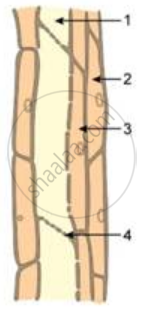
Name the parts labelled 1, 2, 3 and 4.
Advertisements
Solution
1 → Sieve cell
2 → Phloem parenchyma cell
3 → Companion cell
4 → Sieve plate
APPEARS IN
RELATED QUESTIONS
What are the functions of the stomata?
Name the tissue that transports food in plants.
Draw a well labelled diagram of xylem.
Name the different types of elements found in the xylem.
Explain how sieve tubes manage to be living?
Differentiate between cells of Sclerenchyma and Parenchyma
Name the tissue associated with the following:
Conduction of water in the plant body.
Write 'True or False' for the following statement:
Sclerenchyma cells have intercellular spaces.
The question has four answers. Choose the correct answer:
The parenchymatous tissue is
Write a short note on peculiarity of a sclerenchyma cell wall.
