Advertisements
Advertisements
Question
Match the followings and choose the correct option from below
| Column I | Column II |
| A. Meristem | i. Photosynthesis, storage |
| B. Parenchyma | ii. Mechanical support |
| C. Collenchyma | iii. Actively dividing cells |
| D. Sclerenchyma | iv. Stomata |
| E. Epidermal tissue | v. Sclereids |
Options
A - i, B - iii, C - v, D - ii, E - iv
A - iii, B - i, C - ii, D - v, E - iv
A - ii, B - iv, C - v, D - i, E - iii
A - v, B - iv, C - iii, D - ii, E - i
Advertisements
Solution
A - iii, B - i, C - ii, D - v, E - iv
Explanation:
| Column I | Column II |
| A. Meristem | iii. Actively dividing cells |
| B. Parenchyma | i. Photosynthesis, storage |
| C. Collenchyma | ii. Mechanical support |
| D. Sclerenchyma | v. Sclereids |
| E. Epidermal tissue | iv. Stomata |
APPEARS IN
RELATED QUESTIONS
Name the regions in which parenchyma tissue is present.
What is the role of epidermis in plants?
Draw a well-labelled diagram of phloem.
Write a short note on sclerenchyma.
Explain different types of elements present in phloem.
Explain how sieve tubes manage to be living?
Identify the odd word and explain why it is odd.
Name one place in a living organism where the following tissues are located:
Sclerenchyma
Differentiate between cells of Meristematic tissue and Permanent tissue
Study the diagram given below and then answer the question that follows:
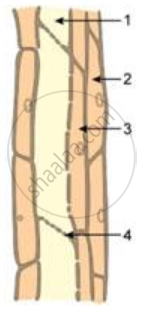
State the function of the parts labelled 1, 2, 3 and 4.
What is a permanent tissue?
Define the following:
Permanent tissue
Give the structure and function of the following:
Sclerenchyma
Give the structure and function of the following:
Crystal
Write 'True or False' for the following statement:
A tracheid is longer than a vessel.
Write a short note on peculiarity of a sclerenchyma cell wall.
Differentiate between Xylem and Phloem functioning
Match the column (A) with the column (B)
| (A) | (B) | ||
| (a) | Parenchyma | (i) | Thin walled, packing cells |
| (b) | Photosynthesis | (ii) | Carbon fixation |
| (c) | Aerenchyma | (iii) | Localized thickenings |
| (d) | Collenchyma | (iv) | Buoyancy |
| (e) | Permanent tissue | (v) | Sclerenchyma |
Fibers are extensively longer ranging from 20 mm to 550 mm ______.
