Advertisements
Advertisements
Question
What are trophic levels? Give an example of a food chain and state the different trophic levels in it.
Advertisements
Solution 1
The various links or steps in a food chain at which the transfer of food and energy takes place are called trophic levels.
The producers form the first trophic level as they manufacture food. The primary consumers form the second trophic level, the secondary consumers form the third, and the tertiary consumers form the fourth trophic level.
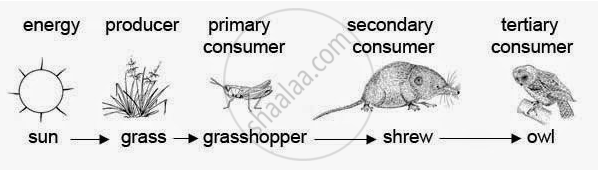
In the above fig. The grass is the producer, which is eaten by the grasshopper, known as the primary consumer. Then the grasshopper is eaten by a shrew, a secondary consumer, and lastly shrew is eaten up by an owl, a tertiary consumer.
Solution 2
The various steps in food chain at which transfer of food energy takes place are called trophic levels.
Example: Food chain operating in a grassland.
Grass → Insects → Frogs → Snakes
- Grass → 1 st trophic level
- Insects → 2 nd trophic level
- Frogs → 3 rd trophic level
- Birds → 4 th trophic level
APPEARS IN
RELATED QUESTIONS
Why are plants called producers?
Which category of organisms forms the starting point of a food chain?
Fill in the following blank with suitable word :
In nature, all green plants are............ whereas animals are consumers.
At which trophic level a person is feeding when he is eating bread.
A student went to study a local pond. In one part of the pond she noticed tadpoles scraping at some pond weed. In another part she saw a water beetle holding a tadpole in its jaws.
(a) Construct a food chain for the pond.
(b) How many links are there in this chain?
Construct a long food chain.
Write a common food chain of a pond ecosystem having four links.
In a food chain, the initial organism is usually :
(a) photosynthetic
(b) herbivore
(c) saprophytic
(d) parasitic
If a grasshopper is eaten by a frog, then the energy transfer will be from ______.
One of the following is not a consumer. This one is :
(a) giraffe
(b) antelope
(c) algae
(d) alligator
In the food chain comprising of a snake, grass, insect, and frog, the secondary consumer is :
(a) insect
(b) snake
(c) frog
(d) grass
Give one example of a food chain having four organisms. Below each organism write the three appropriate terms from the part (a) above which you think it represents.
What does garbage consist of?
Which of the following limits the number of trophic levels in a food chain?
(a) insufficient food supply from producer level
(b) decrease in energy at higher trophic levels
(c) increase in the number of organisms at higher trophic levels
(d) accumulation of harmful chemicals at higher trophic levels
The ten per cent law is associated with
(a) transfer of energy from various trophic levels to decomposers in a food chain
(b) transfer of ATP energy into muscular energy
(c) transfer of chemical energy from one organism to another
(d) transfer of sun's energy to the organisms called producers.
A food chain consists of fish, larvae, phytoplanktons and birds. The level of pesticides in water in which the fish, larvae and phytoplanktons live is quite high.
(a) In which organisms the pesticides enter from the polluted water? What is this level of organisms known as?
The process of accumulation of harmful chemical substances like pesticides, in the body of living organisms at each trophic level of a food chain is known as ______.
If 100 J energy is available at the producer level in a food chain then the energy available to the secondary consumer will be ______.
______ obtained energy from the chemical breakdown of dead organisms.
DDT was sprayed in a lake to regulate breeding of mosquitoes. How would it affect the trophic levels in the following food chain associated with a lake? Justify your answer.
