Advertisements
Advertisements
प्रश्न
What are trophic levels? Give an example of a food chain and state the different trophic levels in it.
Advertisements
उत्तर १
The various links or steps in a food chain at which the transfer of food and energy takes place are called trophic levels.
The producers form the first trophic level as they manufacture food. The primary consumers form the second trophic level, the secondary consumers form the third, and the tertiary consumers form the fourth trophic level.
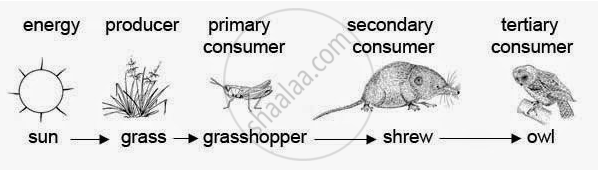
In the above fig. The grass is the producer, which is eaten by the grasshopper, known as the primary consumer. Then the grasshopper is eaten by a shrew, a secondary consumer, and lastly shrew is eaten up by an owl, a tertiary consumer.
उत्तर २
The various steps in food chain at which transfer of food energy takes place are called trophic levels.
Example: Food chain operating in a grassland.
Grass → Insects → Frogs → Snakes
- Grass → 1 st trophic level
- Insects → 2 nd trophic level
- Frogs → 3 rd trophic level
- Birds → 4 th trophic level
APPEARS IN
संबंधित प्रश्न
Explain how the pesticides enter a food chain and subsequently get into our body.
Which of the following belong to the same trophic level?
Goat ; Spider ; Plants ; Hawk ; Rat
Which of the following belong to the same trophic level?
Tree ; Frog ; Snake ; Grass ; Lizard
Define decomposers.
A student went to study a local pond. In one part of the pond she noticed tadpoles scraping at some pond weed. In another part she saw a water beetle holding a tadpole in its jaws.
(a) Construct a food chain for the pond.
(b) How many links are there in this chain?
Write one or two word for the following statement/definition :
Each level of food chain where transfer of energy takes place
Organisms of a higher trophic level which feed on several types of organisms belonging to a number of lower trophic levels constitute the ______.
One of the following is not a consumer. This one is :
(a) giraffe
(b) antelope
(c) algae
(d) alligator
The sea water contains water beetles, tadpole, fish and weeds.
Which organisms can trap solar energy to make food?
The sea water contains water beetles, tadpole, fish and weeds.
Which organism is a secondary consumer?
A food chain occurring in the sea which provides food for many people can be written as :
phytoplankton → zooplankton → X → Y
Which organism in the above food chain is a (1) primary consumer, and (2) tertiary consumer?
What would happen to the number of rabbits and grass plants if the number of foxes increased?
Fill in the following blank with suitable word :
Plants → Antelope → ............
Name and state the law given by Lindeman which tells us how much energy entering a particular trophic level of organisms is available for trasnsfer to the next higher trophic level.
How much energy will be available to hawks in the food chain comprising hawk, snake, paddy and mice, if 10,000 J of energy is available to paddy from the sun?
Which of the following limits the number of trophic levels in a food chain?
(a) insufficient food supply from producer level
(b) decrease in energy at higher trophic levels
(c) increase in the number of organisms at higher trophic levels
(d) accumulation of harmful chemicals at higher trophic levels
______ obtained energy from the chemical breakdown of dead organisms.
Define – Heterotrophs.
In the given food chain, suppose the amount of energy at the fourth trophic level is 5 kJ, what will be the energy available at the producer level?
Grass → Grasshopper → Frog → Snake → Hawk
If a harmful chemical enters a food chain comprising peacocks, plants, rats and snakes, which of these organisms is likely to have the highest concentration of the chemical in its body? Justify your answer. Name the process involved and define it.
