Advertisements
Advertisements
प्रश्न
What are trophic levels? Give an example of a food chain and state the different trophic levels in it.
Advertisements
उत्तर १
The various links or steps in a food chain at which the transfer of food and energy takes place are called trophic levels.
The producers form the first trophic level as they manufacture food. The primary consumers form the second trophic level, the secondary consumers form the third, and the tertiary consumers form the fourth trophic level.
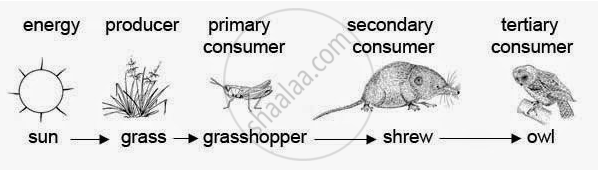
In the above fig. The grass is the producer, which is eaten by the grasshopper, known as the primary consumer. Then the grasshopper is eaten by a shrew, a secondary consumer, and lastly shrew is eaten up by an owl, a tertiary consumer.
उत्तर २
The various steps in food chain at which transfer of food energy takes place are called trophic levels.
Example: Food chain operating in a grassland.
Grass → Insects → Frogs → Snakes
- Grass → 1 st trophic level
- Insects → 2 nd trophic level
- Frogs → 3 rd trophic level
- Birds → 4 th trophic level
APPEARS IN
संबंधित प्रश्न
State with reason any two possible consequences of elimination of decomposers from the Earth.
Will the impact of removing all the organisms in a trophic level be different for different trophic levels? Can the organisms of any trophic level be removed without causing any damage to the ecosystem?
What is biological magnification?
Why are plants called producers?
A food chain represents a unidirectional flow of X. What is X?
Explain the terms 'producer' and 'consumer'. Give two examples of producers and two of consumers.
What is the difference between the food habits of organisms belonging to the first and the third trophic levels? Give one example each of the organisms belonging to these two trophic levels.
The sea water contains water beetles, tadpole, fish and weeds.
Which organisms in the food chain are herbivore, and carnivores?
The sea water contains water beetles, tadpole, fish and weeds.
Which organism is a secondary consumer?
A food chain occurring in the sea which provides food for many people can be written as :
phytoplankton → zooplankton → X → Y
Name the organism which Y could be.
What would happen to the number of rabbits and grass plants if the number of foxes increased?
Give one example of a food chain having four organisms. Below each organism write the three appropriate terms from the part (a) above which you think it represents.
Name two predators of snakes in a food web operating in a forest ecosystem.
The ten per cent law is associated with
(a) transfer of energy from various trophic levels to decomposers in a food chain
(b) transfer of ATP energy into muscular energy
(c) transfer of chemical energy from one organism to another
(d) transfer of sun's energy to the organisms called producers.
What are decomposers? What will be the consequence if the decomposers are completely eradicated from an ecosystem? Give justification in support of your answer.
Bacteria and fungi are called decomposers.
Food chains are very important for the survival of most species.

Matter and energy are two fundamental inputs of an ecosystem. Movement of:
Define – Heterotrophs.
Differentiate between herbivores and carnivores.
Assertion (A): The energy which passes to the herbivores does not come back to autotrophs.
Reason (R): The flow of energy in a food chain is unidirectional.
