Advertisements
Advertisements
Question
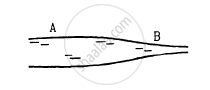
Water flows through a horizontal tube of variable cross section. The area of cross section at A and B are 4 mm2 and 2 mm2 respectively. If 1 cc of water enters per second through A, find (a) the speed of water at A, (b) the speed of water at B and (c) the pressure difference PA − PB.
Advertisements
Solution
(a) Given:
The areas of cross-sections of the tube at A and B are 4 mm2 and 2 mm2, respectively.
1 cc of water enters per second through A.
Let:
PA = Pressure of liquid at A
PB = Pressure of liquid at B
\[ \Rightarrow a_A \times V_A = Q_A \]
\[\text{ Given: }\]
\[ a_A = 4 {\text{ mm }}^2 = 4 \times {10}^{- 2} {\text{cm}}^2 \]
\[ \therefore 4 \times {10}^{- 2} \times V_A = 1\text{cc/s} \]
\[ \Rightarrow V_A = 25 \text{ m/s}\]
\[(b) a_A \times V_A = a_B \times V_B \]
\[ \Rightarrow 4 \times {10}^{- 2} \times 25 = 2 \times {10}^{- 2} \times V_B \]
\[ \Rightarrow V_B = 50 \text{ cm/s}\]
\[ \Rightarrow ( P_A - P_B ) = \frac{1}{2}\rho\left( v_B^2 - \text{v}_A^2 \right)\]
\[ = \frac{1}{2} \times 1 \times (2500 - 625)\]
\[ = \frac{1875}{2} = 937 . 5 \text{dyn/ {cm}}^2 \]
\[ = 93 . 75 \text{N/ m}^2\]
APPEARS IN
RELATED QUESTIONS
Explain why Atmospheric pressure at a height of about 6 km decreases to nearly half of its value at the sea level, though the height of the atmosphere is more than 100 km
Toricelli’s barometer used mercury. Pascal duplicated it using French wine of density 984 kg m–3. Determine the height of the wine column for normal atmospheric pressure.
Two vessels have the same base area but different shapes. The first vessel takes twice the volume of water that the second vessel requires to fill up to a particular common height. Is the force exerted by the water on the base of the vessel the same in the two cases? If so, why do the vessels filled with water to that same height give different readings on a weighing scale?
A plane is in level flight at a constant speed and each of its two wings has an area of 25 m2. If the speed of the air is 180 km/h over the lower wing and 234 km/h over the upper wing surface, determine the plane’s mass. (Take air density to be 1 kg m–3).
It is easier to hammer a blunt nail into a piece of wood than a sharply pointed nail.
1 kgf = .............. (nearly).
The unit of thrust is ..........
Pressure is the thrust acting on a surface of ........... area.
Define the term ‘pressure’ and state its unit.
It is easier to cut with a sharp knife than with a blunt one. Explain.
A normal force of 200 N acts on an area of 0.02 m2. Find the pressure in pascal.
Calculate the pressure in pascal exerted by a force of 300 N acting normally on an area of 30 cm2.
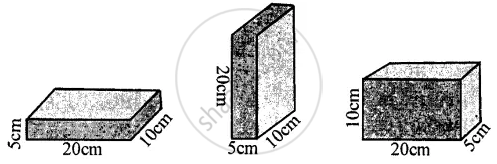
The figure shows a brick of weight 2 kgf and dimensions 20 cm × 10 cm × 5 cm placed in three different positions on the ground. Find the pressure exerted by the brick in each case.
Match the following.
| 1. | Density | hρg |
| 2. | 1 gwt | Milk |
| 3. | Pascal’s law | `"Mass"/" Volume"` |
| 4. | Pressure exerted by a fluid | Pressure |
| 5. | Lactometer | 980 dyne |
A brick is kept in three different ways on a table as shown in the following figure. The pressure exerted by the brick on the table will be
 |
 |
 |
| A | B | C |
Cooking in a place located at a higher altitude is difficult. Why?
Why do scuba divers wear a special suit while they go into deep sea levels?
The shape and size of the solids do not easily change.
A vessel filled with water is kept on a weighing pan and the scale adjusted to zero. A block of mass M and density ρ is suspended by a massless spring of spring constant k. This block is submerged inside into the water in the vessel. What is the reading of the scale?
