Advertisements
Advertisements
Question
1 kgf = .............. (nearly).
Advertisements
Solution
1 kgf = 10 N (nearly)
APPEARS IN
RELATED QUESTIONS
Explain why Atmospheric pressure at a height of about 6 km decreases to nearly half of its value at the sea level, though the height of the atmosphere is more than 100 km
A 50 kg girl wearing high heel shoes balances on a single heel. The heel is circular with a diameter 1.0 cm. What is the pressure exerted by the heel on the horizontal floor?
For a given thrust, pressure is more on a surface of large j area.
The unit of thrust is ..........
A normal force of 200 N acts on an area of 0.02 m2. Find the pressure in pascal.
The pressure in a liquid at two points in the same horizontal plane are equal. Consider an elevator accelerating upward and a car accelerating on a horizontal road. The above statement is correct in
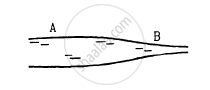
Water flows through a horizontal tube of variable cross section. The area of cross section at A and B are 4 mm2 and 2 mm2 respectively. If 1 cc of water enters per second through A, find (a) the speed of water at A, (b) the speed of water at B and (c) the pressure difference PA − PB.
In a pressure cooker, the food is cooked faster because ______.
Explain the variation of the pressure exerted by liquid with respect to the following factors.
- Amount of liquid
- Depth
- Shape and size of the container
The shape and size of the solids do not easily change.
