Advertisements
Advertisements
Question
Explain why Hydrostatic pressure is a scalar quantity even though the pressure is force divided by area.
Advertisements
Solution
When force is applied on a liquid, the pressure in the liquid is transmitted in all directions. Hence, hydrostatic pressure does not have a fixed direction and it is a scalar physical quantity.
APPEARS IN
RELATED QUESTIONS
The pressure on a surface increases with an increase in the thrust on the surface.
Pressure is the thrust acting on a surface of ........... area.
The feet of lizards act like
It is easier to cut with a sharp knife than with a blunt one. Explain.
A gum bottle rests on its base. If it is placed upside down, how does the thrust change?
How much thrust will be required to exert a pressure of 20,000 Pa on an area of 1 cm2.
The base of a container measures 15 cm × 20 cm. It is placed on a table top. If the weight of the container is 60 N, what is the pressure exerted by the container on the table top?
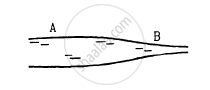
Water flows through a horizontal tube of variable cross section. The area of cross section at A and B are 4 mm2 and 2 mm2 respectively. If 1 cc of water enters per second through A, find (a) the speed of water at A, (b) the speed of water at B and (c) the pressure difference PA − PB.
Match the following.
| 1. | Density | hρg |
| 2. | 1 gwt | Milk |
| 3. | Pascal’s law | `"Mass"/" Volume"` |
| 4. | Pressure exerted by a fluid | Pressure |
| 5. | Lactometer | 980 dyne |
A chapatti maker is a machine which converts balls of dough into chapatties. What effect of force comes into play in this process?
It is difficult to cut cloth using a pair of scissors with blunt blades. Explain.
If the same force is made to act on a larger area, the pressure ______.
Pressure is directly proportional to the area of contact.
Intermolecular forces are stronger in ______.
Fluids in general are ______.
Hot air is ______ dense than ordinary air.
Upthrust = weight of the fluid displaced – apparent weight of the object.
Iceberg floats in water with part of it submerged. What is the fraction of the volume of iceberg submerged if the density of ice is ρi = 0.917 g cm–3?
