Advertisements
Advertisements
Question
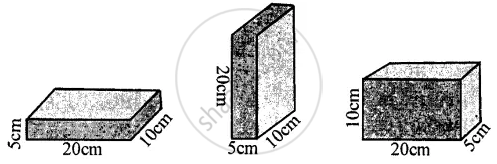
The figure shows a brick of weight 2 kgf and dimensions 20 cm × 10 cm × 5 cm placed in three different positions on the ground. Find the pressure exerted by the brick in each case.
Advertisements
Solution
(a) Weight of bricks = Thrust = F = 2 kgf
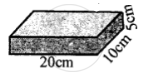
Area of base = `20/100 xx 10/100 = 1/50 "m"^2`
Pressure exerted P = `"F"/"A" = "2 kgf"/(1/50 "m"^2) = 100 "kgf m"^-2`
Or
Area of base = area of top L × B
20 cm × 10 = 200 cm2
P = `"Thrust"/"A" = "2 kgf"/200 "cm"^2 = 1/100 = 0.01 "kgf cm"^-2`
(b)
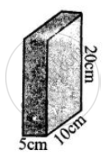
area of base = area of top
= 5 cm × 10 cm = 50 cm2
Pressure exerted = P = `"F"/"A" = "2 kgf"/"50 cm"^2 = 0.04`
P = 0.04 kgf cm-2
(c)
Weight of brick
F = 2 kgf
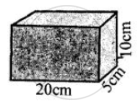
Area of base = L × B
= 20 cm × 5 cm = 100 cm2
Pressure exerted = `"F"/"A" = 2/100 = 0.02 "kgf cm"^-2 `
APPEARS IN
RELATED QUESTIONS
In problem 10.9, if 15.0 cm of water and spirit each are further poured into the respective arms of the tube, what is the difference in the levels of mercury in the two arms? (Specific gravity of mercury = 13.6)
The unit of pressure is
When does a man exert more pressure on the floor: while standing or while walking?
It is easier to cut with a sharp knife than with a blunt one. Explain.
A normal force of 200 N acts on an area of 0.02 m2. Find the pressure in pascal.

A water tank has four taps fixed at points A, B, C, D as shown in the following figure. The water will flow out at the same pressure from taps at
Give reasons why:
heavy trucks are fitted with 6 to 8 wheels
Scuba divers wear special suits to withstand ______.
The pressure in mines is ______ than the sea level.
Define thrust.
