Advertisements
Advertisements
प्रश्न
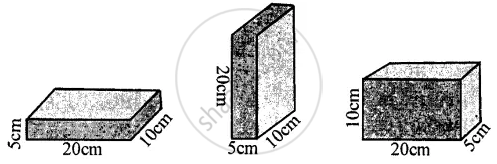
The figure shows a brick of weight 2 kgf and dimensions 20 cm × 10 cm × 5 cm placed in three different positions on the ground. Find the pressure exerted by the brick in each case.
Advertisements
उत्तर
(a) Weight of bricks = Thrust = F = 2 kgf
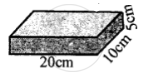
Area of base = `20/100 xx 10/100 = 1/50 "m"^2`
Pressure exerted P = `"F"/"A" = "2 kgf"/(1/50 "m"^2) = 100 "kgf m"^-2`
Or
Area of base = area of top L × B
20 cm × 10 = 200 cm2
P = `"Thrust"/"A" = "2 kgf"/200 "cm"^2 = 1/100 = 0.01 "kgf cm"^-2`
(b)
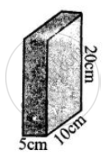
area of base = area of top
= 5 cm × 10 cm = 50 cm2
Pressure exerted = P = `"F"/"A" = "2 kgf"/"50 cm"^2 = 0.04`
P = 0.04 kgf cm-2
(c)
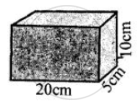
Weight of brick
F = 2 kgf
Area of base = L × B
= 20 cm × 5 cm = 100 cm2
Pressure exerted = `"F"/"A" = 2/100 = 0.02 "kgf cm"^-2 `
APPEARS IN
संबंधित प्रश्न
Explain why Hydrostatic pressure is a scalar quantity even though the pressure is force divided by area.
Toricelli’s barometer used mercury. Pascal duplicated it using French wine of density 984 kg m–3. Determine the height of the wine column for normal atmospheric pressure.
State the unit of thrust
Name two factors on which the pressure on a surface depends.
Why is the bottom part of the foundation of a building made wider?
A normal force of 200 N acts on an area of 0.02 m2. Find the pressure in pascal.
Consider the statement given below and choose the correct option.
Assertion: Sharp knives are used to cut the vegetables.
Reason: Sharp edges exert more pressure.
An empty plastic bottle closed with an airtight stopper is pushed down into a bucket filled with water. As the bottle is pushed down, there is an increasing force on the bottom. This is because
The pressure in mines is ______ than the sea level.
What happens when pressure is increased in solids?
