Advertisements
Advertisements
प्रश्न
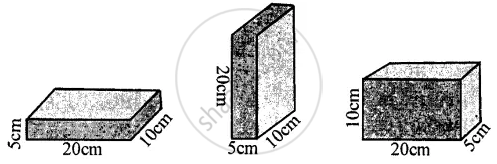
The figure shows a brick of weight 2 kgf and dimensions 20 cm × 10 cm × 5 cm placed in three different positions on the ground. Find the pressure exerted by the brick in each case.
Advertisements
उत्तर
(a) Weight of bricks = Thrust = F = 2 kgf
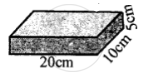
Area of base = `20/100 xx 10/100 = 1/50 "m"^2`
Pressure exerted P = `"F"/"A" = "2 kgf"/(1/50 "m"^2) = 100 "kgf m"^-2`
Or
Area of base = area of top L × B
20 cm × 10 = 200 cm2
P = `"Thrust"/"A" = "2 kgf"/200 "cm"^2 = 1/100 = 0.01 "kgf cm"^-2`
(b)
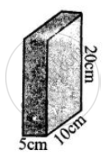
area of base = area of top
= 5 cm × 10 cm = 50 cm2
Pressure exerted = P = `"F"/"A" = "2 kgf"/"50 cm"^2 = 0.04`
P = 0.04 kgf cm-2
(c)
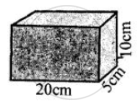
Weight of brick
F = 2 kgf
Area of base = L × B
= 20 cm × 5 cm = 100 cm2
Pressure exerted = `"F"/"A" = 2/100 = 0.02 "kgf cm"^-2 `
APPEARS IN
संबंधित प्रश्न
The feet of lizards act like
Name two factors on which the pressure on a surface depends.
It is easier to cut with a sharp knife than with a blunt one. Explain.
A gum bottle rests on its base. If it is placed upside down, how does the pressure change?
Find the area of a body which experiences a pressure of 50000 Pa by a thrust of 100 N?
The base of a container measures 15 cm × 20 cm. It is placed on a table top. If the weight of the container is 60 N, what is the pressure exerted by the container on the table top?
A beaker containing a liquid is kept inside a big closed jar. If the air inside the jar is continuously pumped out, the pressure in the liquid near the bottom of the liquid will
Give reasons why:
cutting edges of knives and axes are sharpened.
The shape and size of the solids do not easily change.
Pressure is a scalar quantity because ______.
- it is the ratio of force to area and both force and area are vectors.
- it is the ratio of the magnitude of the force to area.
- it is the ratio of the component of the force normal to the area.
- it does not depend on the size of the area chosen.
