Advertisements
Advertisements
Question
A vessel filled with water is kept on a weighing pan and the scale adjusted to zero. A block of mass M and density ρ is suspended by a massless spring of spring constant k. This block is submerged inside into the water in the vessel. What is the reading of the scale?
Advertisements
Solution
As shown in the diagram, A block of mass M and density p is suspended by a massless spring of spring constants k. This block is submerged in the water in the vessel.
The scale is adjusted to zero, therefore, when the block suspended in spring is immersed in water, then the reading of the scale will be equal to the upthrust on the block due to water.
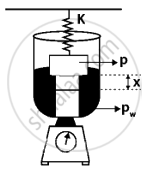
As we submerge the block into the water, a force equal to the weight of the block acts upward in the form of a buoyant force. So, the downward force applied by the block equals to VPwg
V = the water volume which is displaced by the block
Pw = density of water
Mass of block = M = V
`V = M/p`
So, the reading on the weighing scale reads: `M/p.p_wg = p_w/p M g`
Important point: If the scale is not adjusted to zero as said earlier, the reading on the scale will be different. The weight of the vessel and the weight of water is also added to the reading.
APPEARS IN
RELATED QUESTIONS
Explain why Atmospheric pressure at a height of about 6 km decreases to nearly half of its value at the sea level, though the height of the atmosphere is more than 100 km
Explain why Hydrostatic pressure is a scalar quantity even though the pressure is force divided by area.
A plane is in level flight at a constant speed and each of its two wings has an area of 25 m2. If the speed of the air is 180 km/h over the lower wing and 234 km/h over the upper wing surface, determine the plane’s mass. (Take air density to be 1 kg m–3).
A large He balloon of volume 1425 m3 is used to lift a payload of 400 kg. Assume that the balloon maintains constant radius as it rises. How high does it rise? [Take y0= 8000 m and `rho_"He"`= 0.18 kg m–3].
The S.I. unit of pressure is pascal.
Water in a lake exerts pressure only at its bottom.
The unit of thrust is
A body weighing 5 kgf, placed on a surface of area 0.1 m2, exerts a thrust on the surface equal to
Find the thrust required to exert a pressure of 50000 pascals on an area of 0.05 m2 ?
Find the area of a body which experiences a pressure of 50000 Pa by a thrust of 100 N?
Multiple Choice Question.
A hydraulic lift is designed to lift heavy objects of maximum mass 2000 kg. The area of cross-section of piston carrying the load is 2.25 × 10⁻² m2. What is the maximum pressure the smaller piston would have to bear?
Consider the statement given below and choose the correct option.
Assertion: Sharp knives are used to cut the vegetables.
Reason: Sharp edges exert more pressure.
In a pressure cooker, the food is cooked faster because ______.
It is difficult to cut cloth using a pair of scissors with blunt blades. Explain.
The total force exerted by a body normal to the surface is called ______.
The net force in a particular direction is called ______.
The pressure in mines is ______ than the sea level.
Iceberg floats in water with part of it submerged. What is the fraction of the volume of iceberg submerged if the density of ice is ρi = 0.917 g cm–3?
