Advertisements
Advertisements
Question
If someone presses a pointed needle against your skin, you are hurt. But if someone presses a rod against your skin with the same force, you easily tolerate. Explain.
Advertisements
Solution
We know that pressure is the application of force over a particular area. In mathematical terms, pressure is equal to force divided by area; that is, with more force comes more pressure and with more area comes less pressure. An iron rod has more surface area than the pointed tip of a needle. That is why the pointed needle exerts more pressure than the iron rod (with the same force) when pressed against our skin.
APPEARS IN
RELATED QUESTIONS
In problem 10.9, if 15.0 cm of water and spirit each are further poured into the respective arms of the tube, what is the difference in the levels of mercury in the two arms? (Specific gravity of mercury = 13.6)
A man exerts same pressure on the ground whether he is standing or he is lying.
A body weighing 5 kgf, placed on a surface of area 0.1 m2, exerts a thrust on the surface equal to
Define the term ‘pressure’ and state its unit.
How is the thrust related to pressure?
When does a man exert more pressure on the floor: while standing or while walking?
It is easier to cut with a sharp knife than with a blunt one. Explain.
A gum bottle rests on its base. If it is placed upside down, how does the thrust change?
The figure shows a brick of weight 2 kgf and dimensions 20 cm × 10 cm × 5 cm placed in three different positions on the ground. Find the pressure exerted by the brick in each case.
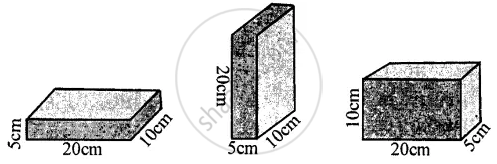
In a hydraulic lift, the input piston had surface area 30 cm2 and the output piston has surface area of 1500 cm2. If a force of 25 N is applied to the input piston, calculate weight/force on output piston.
A chapatti maker is a machine which converts balls of dough into chapatties. What effect of force comes into play in this process?
Cooking in a place located at a higher altitude is difficult. Why?
Why dams are made stronger and thicker at the bottom than at the top?
Why do scuba divers wear a special suit while they go into deep sea levels?
It is easy to compress a gas whereas liquids are ______.
Hot air is ______ dense than ordinary air.
What happens when pressure is increased in solids?
Pressure is a scalar quantity because ______.
- it is the ratio of force to area and both force and area are vectors.
- it is the ratio of the magnitude of the force to area.
- it is the ratio of the component of the force normal to the area.
- it does not depend on the size of the area chosen.
Iceberg floats in water with part of it submerged. What is the fraction of the volume of iceberg submerged if the density of ice is ρi = 0.917 g cm–3?
