Advertisements
Advertisements
Question
Using the necessary circuit diagrams, show how the V-I characteristics of a p-n junction are obtained in
Forward biasing
How are these characteristics made use of in rectification?
Advertisements
Solution
p-n junction diode under forward bias
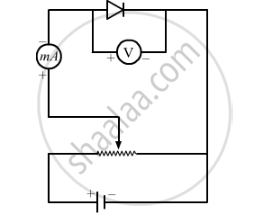
p-side is connected to the positive terminal and n-side to the negative terminal.
Applied voltage drops across the depletion region.
Electron in n-region moves towards the p-n junction and holes in the p-region move towards the junction. The width of the depletion layer decreases and hence, it offers less resistance.
Diffusion of majority carriers takes place across the junction. This leads to the forward current.
The V-I characteristics of p-n junction in forward bias is shown below:

APPEARS IN
RELATED QUESTIONS
With the help of a neat circuit diagram, explain the working of a photodiode.
Explain with the help of a diagram, how depletion region and potential barrier are formed in a junction diode.
Using the necessary circuit diagrams, show how the V-I characteristics of a p-n junction are obtained in
Reverse biasing
How are these characteristics made use of in rectification?
Carbon, silicon and germanium have four valence electrons each. These are characterised by valence and conduction bands separated by energy band gap respectively equal to (Eg)C, (Eg)Si and (Eg)Ge. Which of the following statements is true?
The current in the forward bias is known to be more (~mA) than the current in the reverse bias (~μA). What is the reason, then, to operate the photodiode in reverse bias?
Draw the V-I characteristics of an LED. State two advantages of LED lamps over convertional incandescent lamps.
What is a solar cell?
Draw the circuit diagram of an illuminated photodiode and its I-V characteristics.
How can a photodiode be used to measure light intensity?
Select the wrong statement in the case of LED.
