Advertisements
Advertisements
Question
Two friends A and B (each weighing 40 kg) are sitting on a frictionless platform some distance d apart. A rolls a ball of mass 4 kg on the platform towards B which B catches. Then B rolls the ball towards A and A catches it. The ball keeps on moving back and forth between A and B. The ball has a fixed speed of 5 m/s on the platform. (a) Find the speed of A after he catches the ball for the first time. (c) Find the speeds of A and Bafter the all has made 5 round trips and is held by A. (d) How many times can A roll the ball? (e) Where is the centre of mass of the system "A + B + ball" at the end of the nth trip?
Advertisements
Solution
It is given that:
Weight of A = Weight of B = 40 kg
Velocity of ball = 5 m/s
(a) Case-1: Total momentum of the man A and ball remains constant.
∴ 0 = 4 × 5 − 40 × v
⇒ v = 0.5 m/s, towards left
(b) Case-2: When B catches the ball, the momentum between B and the ball remains constant.
⇒ 4 × 5 = 44 v
⇒ \[v = \left( \frac{20}{44} \right)\text{ m/s}\]
Case-3: When B throws the ball,
On applying the law of conservation of linear momentum, we get:
\[\Rightarrow 44 \times \left( \frac{20}{44} \right) = - 4 \times 5 + 40 \times v\]
\[ \Rightarrow v = 1 \text{ m/s , towards right)}\]
Case-4: When A catches the ball,
Applying the law of conservation of liner momentum, we get:
\[- 4 \times 5 + ( - 0 . 5) \times 40 = 44 v\]
\[ \Rightarrow v = \frac{40}{44} = \frac{10}{11}\text{ m/s, towards left}\]
(c) Case-5: When A throws the ball,
Applying the law of conservation of linear momentum, we get:
\[44 \times \left( \frac{10}{11} \right) = 4 \times 5 + 40 \times v\]
\[ \Rightarrow v = \frac{60}{40} = \frac{3}{2} \text{ m/s towards left)}\]
Case-6: When B receives the ball,
Applying the law of conservation of linear momentum, we get:
\[40 \times 1 + 4 \times 5 = 44 \times v\]
\[ \Rightarrow v = \frac{60}{44} \text{ m/s, towards right }\]
Case-7: When B throws the ball,
On applying the law of conservation of linear momentum, we get:
\[\Rightarrow v = 44 \times \left( \frac{60}{44} \right) \text{ m/s, towards right }\]
Case-8: When A catches the ball,
On applying the law of conservation of linear momentum, we get:
\[- 4 \times 5 + 40\left( \frac{3}{2} \right) = - 44v\]
\[ \Rightarrow V = - \frac{40}{44} = $\left( \frac{10}{11} \right) \text{ m/s,towards left } \]
Similarly, after 5 round trips,
The velocity of A will be \[\left( \frac{50}{11} \right)\] m/s and the velocity of B will be 5 m/s.
(d) As after 6 round trips, the velocity of A becomes \[\frac{60}{11}\] > 5 m/s, it cannot catch the ball. Thus, A can only roll the ball six times.
(e) Let the ball and the body A be at origin, in the initial position.
\[\therefore X_c = \frac{40 \times 0 + 4 \times 0 + 40 \times d}{40 + 40 + 4}\]
\[ = \frac{10}{21}d\]
APPEARS IN
RELATED QUESTIONS
If the total mechanical energy of a particle is zero, is its linear momentum necessarily zero? Is it necessarily nonzero?
Consider the situation of the previous problem. Take "the table plus the ball" as the system. friction between the table and the ball is then an internal force. As the ball slows down, the momentum of the system decreases. Which external force is responsible for this change in the momentum?
Consider the following two statements:
(A) Linear momentum of a system of particles is zero.
(B) Kinetic energy of a system of particles is zero.
A neutron initially at rest, decays into a proton, an electron, and an antineutrino. The ejected electron has a momentum of 1.4 × 10⁻²⁶ kg-m/s and the antineutrino 6.4 × 10⁻²⁷kg-m/s.
Find the recoil speed of the proton
(a) if the electron and the antineutrino are ejected along the same direction and
(b) if they are ejected along perpendicular directions. Mass of the proton = 1.67 × 10⁻²⁷ kg.
Light in certain cases may be considered as a stream of particles called photons. Each photon has a linear momentum h/λ where h is the Planck's constant and λ is the wavelength of the light. A beam of light of wavelength λ is incident on a plane mirror at an angle of incidence θ. Calculate the change in the linear momentum of a photon as the beam is reflected by the mirror.
A gun is mounted on a railroad car. The mass of the car, the gun, the shells and the operator is 50 m where m is the mass of one shell. If the velocity of the shell with respect to the gun (in its state before firing) is 200 m/s, what is the recoil speed of the car after the second shot? Neglect friction.
In a typical Indian Bugghi (a luxury cart drawn by horses), a wooden plate is fixed on the rear on which one person can sit. A bugghi of mass 200 kg is moving at a speed of 10 km/h. As it overtakes a school boy walking at a speed of 4 km/h, the boy sits on the wooden plate. If the mass of the boy is 25 kg, what will be the plate. If the mass of the boy is 25 kg, what will be the new velocity of the bugghi ?
A 60 kg man skating with a speed of 10 m/s collides with a 40 kg skater at rest and they cling to each other. Find the loss of kinetic energy during the collision.
A ball of mass m moving at a speed v makes a head-on collision with an identical ball at rest. The kinetic energy of the balls after the collision is three fourths of the original. Find the coefficient of restitution.
In a gamma decay process, the internal energy of a nucleus of mass M decreases, a gamma photon of energy E and linear momentum E/c is emitted and the nucleus recoils. Find the decrease in internal energy.
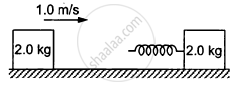
A block of mass 2.0 kg is moving on a frictionless horizontal surface with a velocity of 1.0 m/s (In the following figure) towards another block of equal mass kept at rest. The spring constant of the spring fixed at one end is 100 N/m. Find the maximum compression of the spring.
A bullet of mass 20 g travelling horizontally with a speed of 500 m/s passes through a wooden block of mass 10.0 kg initially at rest on a level surface. The bullet emerges with a speed of 100 m/s and the block slides 20 cm on the surface before coming to rest. Find the friction coefficient between the block and the surface (See figure).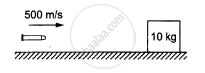
A block of mass 200 g is suspended through a vertical spring. The spring is stretched by 1.0 cm when the block is in equilibrium. A particle of mass 120 g is dropped on the block from a height of 45 cm. The particle sticks to the block after the impact. Find the maximum extension of the spring. Take g = 10 m/s2.
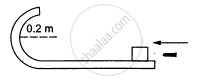
A bullet of mass 10 g moving horizontally at a speed of 50√7 m/s strikes a block of mass 490 g kept on a frictionless track as shown in figure. The bullet remains inside the block and the system proceeds towards the semicircular track of radius 0.2 m. Where will the block strike the horizontal part after leaving the semicircular track?
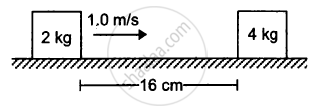
The friction coefficient between the horizontal surface and each of the block shown in figure is 0.20. The collision between the blocks is perfectly elastic. Find the separation between the two blocks when they come to rest. Take g = 10 m/s2.
A solid sphere of mass m is released from rest from the rim of a hemispherical cup so that it rolls along the surface. If the rim of the hemisphere is kept horizontal, find the normal force exerted by the cup on the ball when the ball reaches the bottom of the cup.
A thin spherical shell of radius R lying on a rough horizontal surface is hit sharply and horizontally by a cue. Where should it be hit so that the shell does not slip on the surface?
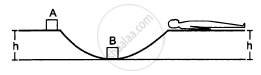
The track shown is figure is frictionless. The block B of mass 2m is lying at rest and the block A or mass m is pushed along the track with some speed. The collision between Aand B is perfectly elastic. With what velocity should the block A be started to get the sleeping man awakened?