Advertisements
Advertisements
Question
Two charges 2 μC and −2 µC are placed at points A and B 6 cm apart.
- Identify an equipotential surface of the system.
- What is the direction of the electric field at every point on this surface?
Advertisements
Solution
- The situation is represented in the given figure.

An equipotential surface is a plane on which total potential is zero everywhere. This plane is normal to line AB. The plane is located at the mid-point of line AB because the magnitude of charges is the same. - The direction of the electric field at every point on this surface is normal to the plane in the direction of AB.
APPEARS IN
RELATED QUESTIONS
Define an equipotential surface.
The discharging current in the atmosphere due to the small conductivity of air is known to be 1800 A on an average over the globe. Why then does the atmosphere not discharge itself completely in due course and become electrically neutral? In other words, what keeps the atmosphere charged?
Draw equipotential surfaces:
(1) in the case of a single point charge and
(2) in a constant electric field in Z-direction. Why are the equipotential surfaces about a single charge not equidistant?
(3) Can electric field exist tangential to an equipotential surface? Give reason
What is the geometrical shape of equipotential surfaces due to a single isolated charge?
Define equipotential surface.
Two identical point charges, q each, are kept 2m apart in the air. A third point charge Q of unknown magnitude and sign is placed on the line joining the charges such that the system remains in equilibrium. Find the position and nature of Q.
Draw the equipotential surfaces due to an electric dipole.
Find the amount of work done in rotating an electric dipole of dipole moment 3.2 x 10- 8Cm from its position of stable equilibrium to the position of unstable equilibrium in a uniform electric field if intensity 104 N/C.
A particle of mass 'm' having charge 'q' is held at rest in uniform electric field of intensity 'E'. When it is released, the kinetic energy attained by it after covering a distance 'y' will be ______.
The diagrams below show regions of equipotentials.
(i)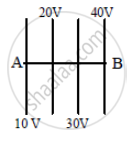 |
(ii) |
(iii)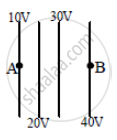 |
(iv)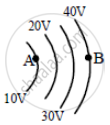 |
A positive charge is moved from A to B in each diagram.
Which of the following is NOT the property of equipotential surface?
Can two equipotential surfaces intersect each other?
Equipotential surfaces ______.
- are closer in regions of large electric fields compared to regions of lower electric fields.
- will be more crowded near sharp edges of a conductor.
- will be more crowded near regions of large charge densities.
- will always be equally spaced.
Prove that a closed equipotential surface with no charge within itself must enclose an equipotential volume.
Find the equation of the equipotentials for an infinite cylinder of radius r0, carrying charge of linear density λ.
