Advertisements
Advertisements
Question
Transpiration is the loss of water as water ______ from the ______ parts of the plant.
Advertisements
Solution
Transpiration is the loss of water as water vapour from the aerial parts of the plant.
APPEARS IN
RELATED QUESTIONS
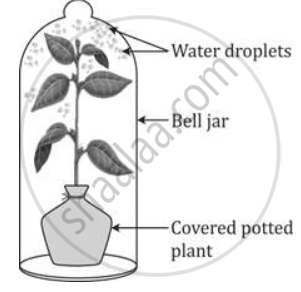
An apparatus, as shown below, was set up to investigate a physiological process in plants. The setup was kept in sunlight for two hours. Droplets of water were then seen inside the bell jar. Answer the questions that follow:

- Name the process being studied.
- Explain the process named above in Q.3(a)(i).
- Why was the pot covered with a plastic sheet?
- Suggest a suitable control for this experiment.
- Mention two ways in which this process is beneficial to plants.
- List three adaptations in plants to reduce the above mentioned process.
Fill in the blank:
Water is lost from the leaves by__________.
(a) State whether the following statement are True or False.
(b) Rewrite the false statement in the correct form by changing either the first or the last word only.
Most transpiration occurs at midnight.
Distinguish between the following :
Cuticular transpiration and lenticular transpiration
The figure below represents the set-up at the start of certain experiment to demonstrate an activity of plants:
(i) What is the aim of the experiment?
(ii) Why has oil been put in each test tube?
(iii) What will be the observations in the two test-tubes after about 2-3 days?
(iv) Give reasons to explain any change observed as answered in (iii) above.
(v) Why has the test-tube b without the plant, been taken in the experiment?

An apparatus as shown below was set up to investigate a physiological process in plants. The setup was kept in sunlight for two hours. Droplets of water were then seen inside the bell jar. Answer the questions that follow:
Explain the process named above in 7.1.
What governs the opening and closing of stomata?
Name the cell that surrounds the stoma.
Transpiration is a necessary evil in plants. Explain.
Keep some freshly cut flowers in a solution of food colour. Wait for sometime for the dye to rise in the flower, when the stem of the flower is held up in light, coloured strands can be seen inside. Can this experiment demonstrate which tissue is conducting water up the stem?
