Advertisements
Advertisements
Question
An apparatus as shown below was set up to investigate a physiological process in plants. The setup was kept in sunlight for two hours. Droplets of water were then seen inside the bell jar. Answer the questions that follow:
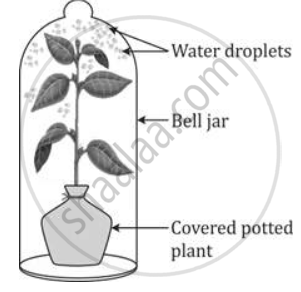
Explain the process named above in 7.1.
Advertisements
Solution
Transpiration is a process during which water is lost in the form of water vapour through aerial parts of the plant.
RELATED QUESTIONS
What are stomata?
Under what conditions do plant transpire more quickly?
Define the three processes by which plants absorb water and minerals from the soil.
How does transpiration help in the uptake of water from the soil?
Given alongside is the diagram of an experimental set-up to demonstrate a certain phenomenon in plants.

Would it make a difference if the experimental set-up is kept in bright sunshine?
Boojho’s uncle was hospitalised and put on dialysis after a severe infection in both of his kidneys.
What is dialysis?
Why is transpiration called a necessary evil?
Do different species of plants growing in the same area show the same rate of transpiration at a particular time? Justify your answer.
Observe the diagram and answer the following;
![]() (i) |
![]() (ii) |
- Are these types of guard cells found in monocots or dicots?
- Which of these shows a higher water content (i) or (ii)?
- Which element plays an important role in the opening and closing of stomata?
The radio labelled carbon in carbon dioxide supplied to potato plants in an experiment was seen in the tuber eventually. Trace the movement of the labelled carbon dioxide.


